
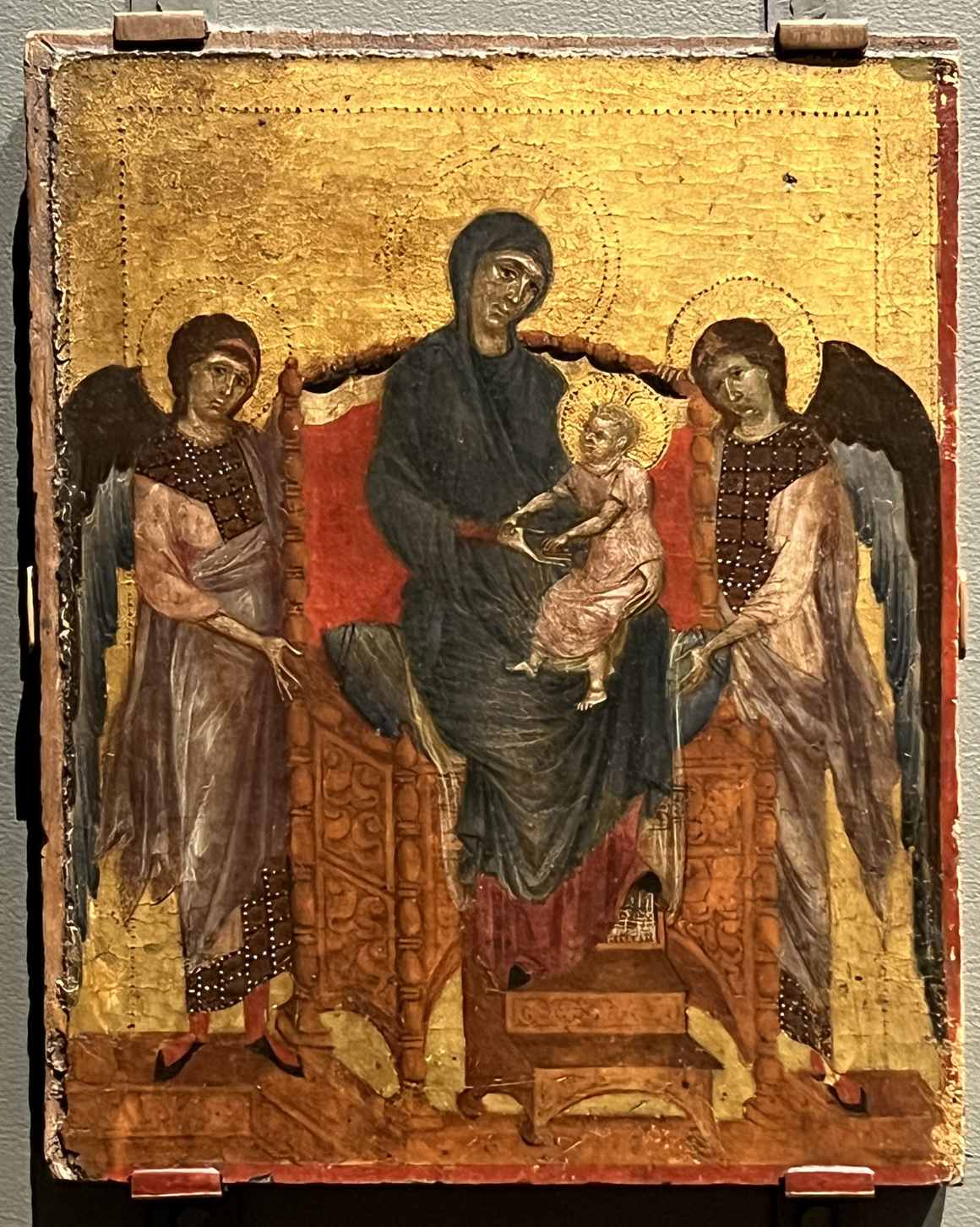
Cimabue — The Virgin and Child with Two Angels, about 1280-5
This is a revolutionary approach to a traditional image. Cimabue was one of the first Italian painters to apply a new naturalism to traditional Byzantine compositions. Here, the child tenderly touches his mother's hand. Her throne is placed at an angle to create a sense of space. The panel comes from a small devotional work painted with scenes from Christ's life.
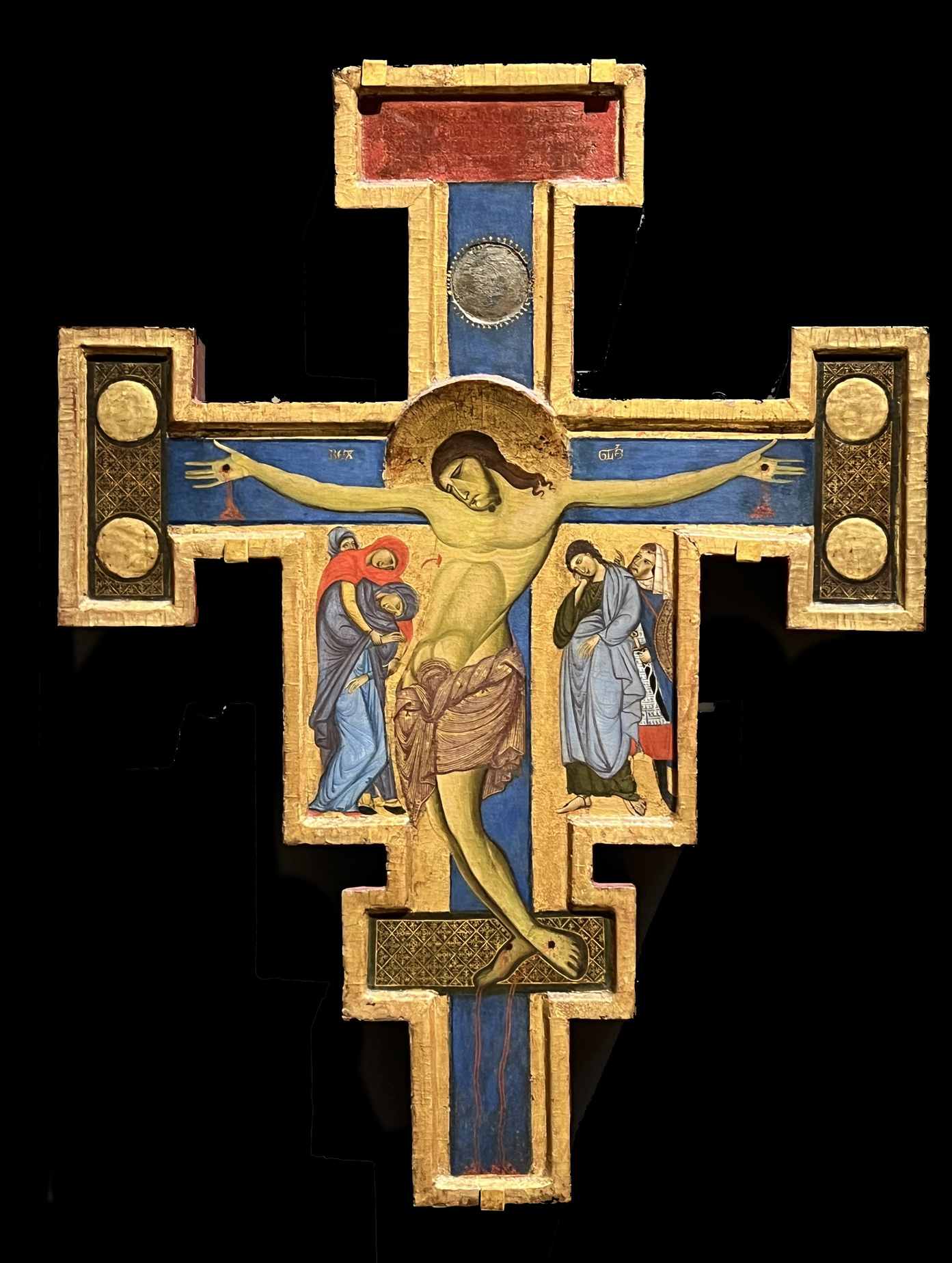
Master of Saint Francis — Crucifix, about 1265-70
Christ's limp body sways away from the Cross, while bright blood flows and pools from his wounds. His mother, crumbling in an agony of grief, is gathered in the arms of Mary Magdalene. The hollow roundel may have contained a relic, perhaps a fragment of the Cross. The artist takes his name from paintings of Saint Francis that he made in Assisi.
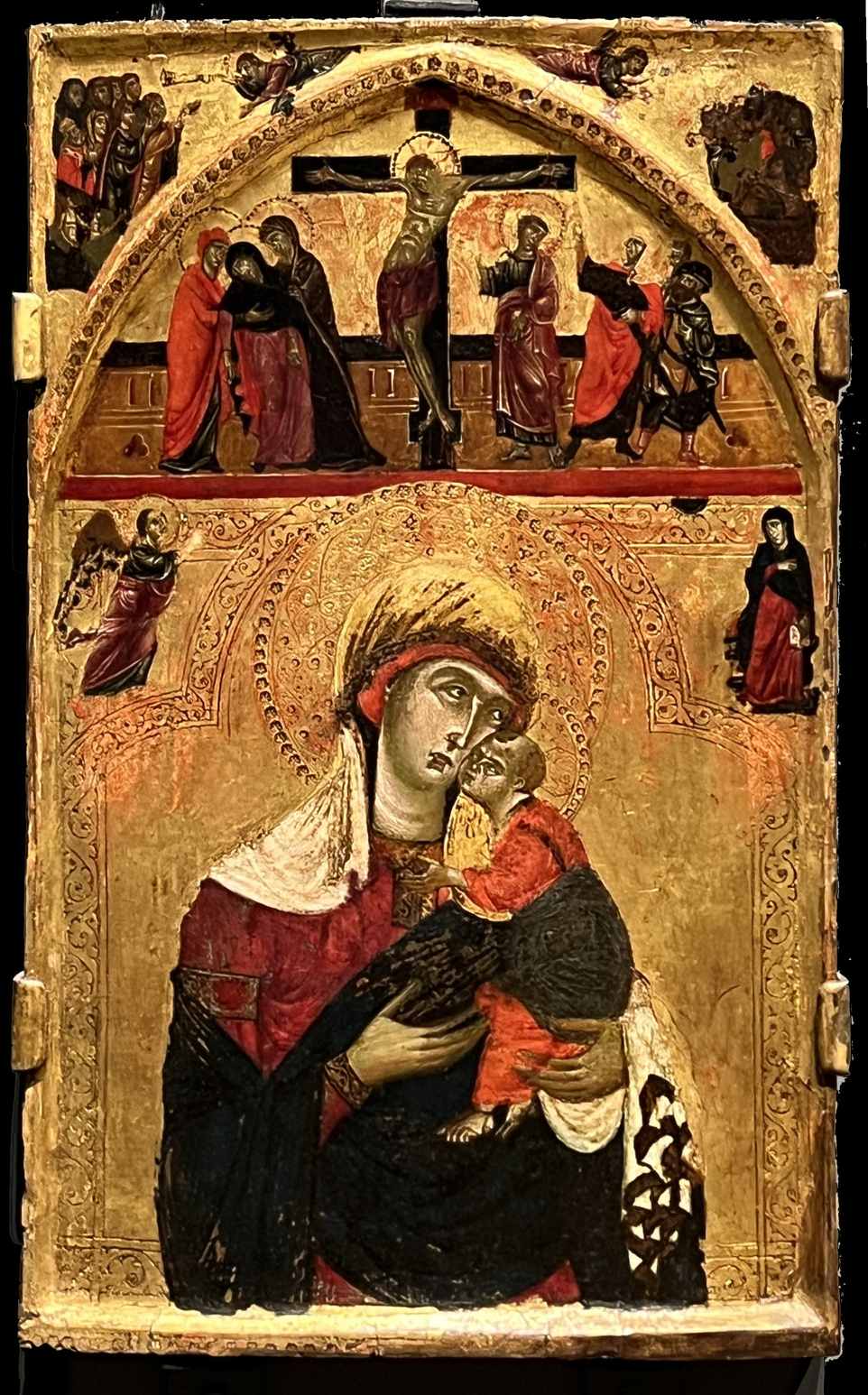
Master of the Clarisse — The Virgin and Child, about 1265-8
To either side of the embracing Virgin and Child, the Archangel Gabriel announces Christ's imminent birth to the Virgin. Above, she swoons at the sight of her son bleeding on the Cross. At the top, trumpeting angels wake the dead from their graves, including a black-hooded monk and a Franciscan friar. The panel has probably lost an uppermost image of Christ presiding over the Last Judgment.
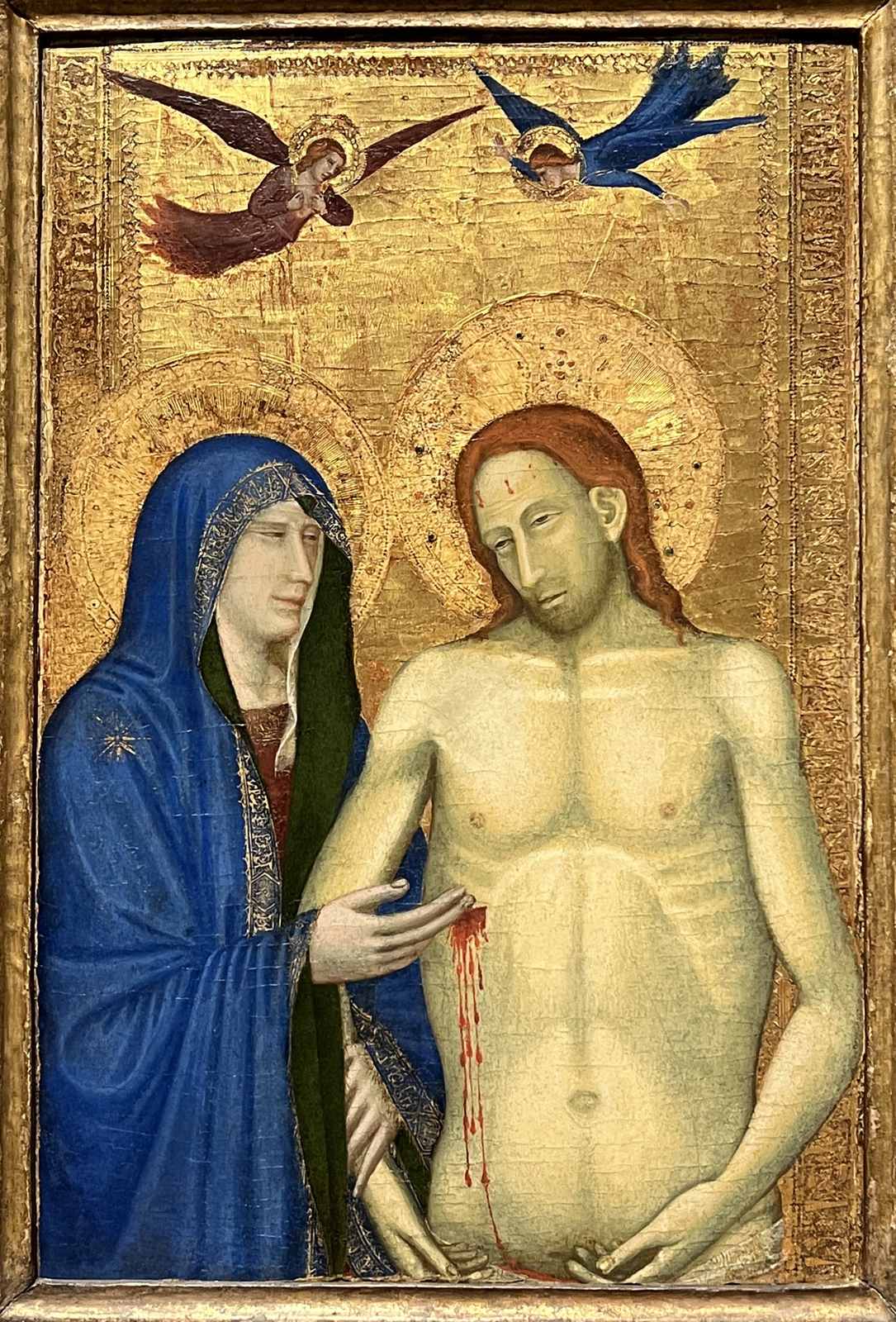
Neapolitan follower of Giotto — The Dead Christ and the Virgin, probably 1330s-40s
The grieving Virgin clutches her dead son's arm and presses long fingers to his dripping wound. Blood pools in his revealing loincloth. This panel may be half of a diptych commissioned for the personal use of Queen Sancia of Naples (about 1281-1345). She had a particular devotion to Christ's body, which is prominently depicted here.
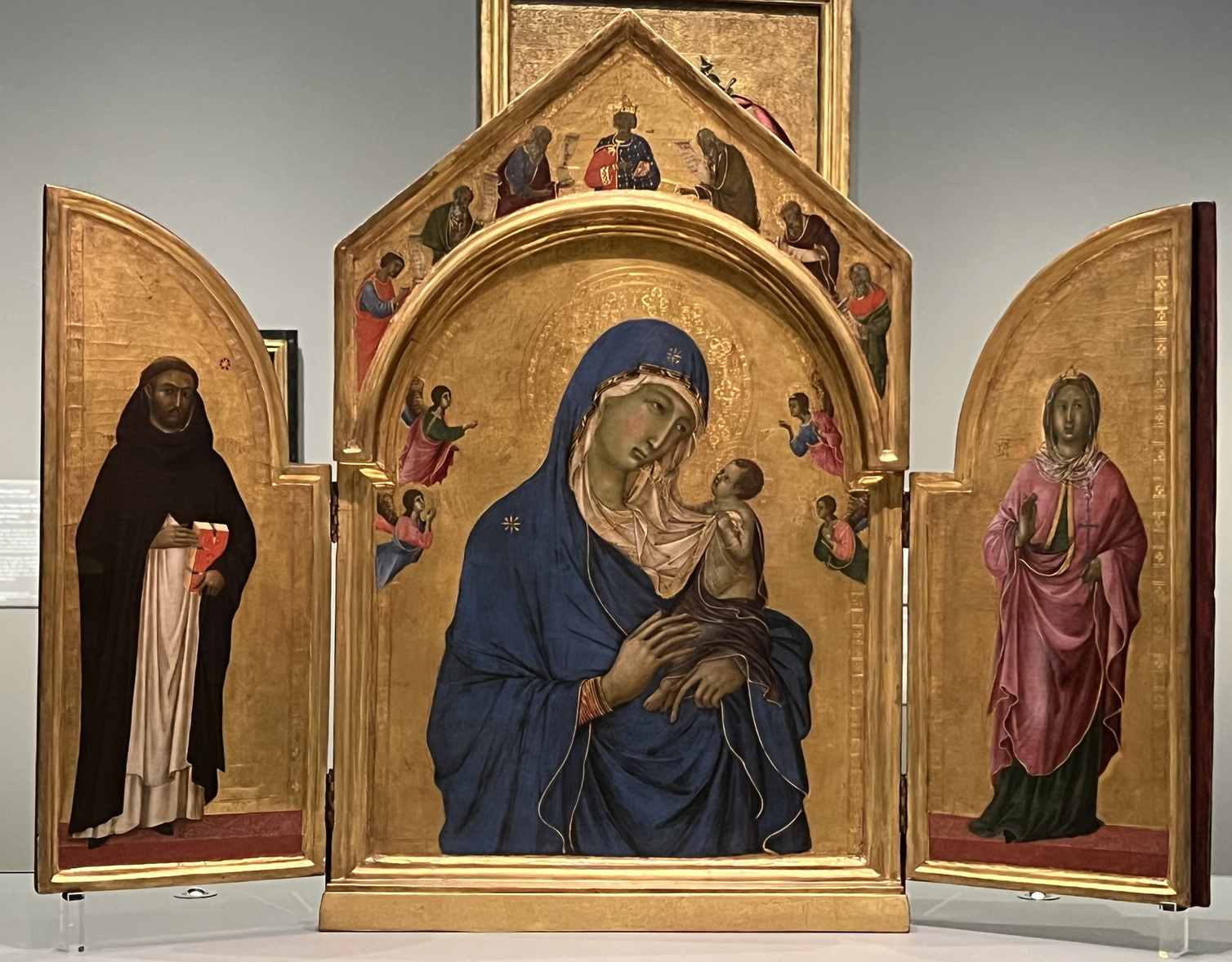
Duccio — The Virgin and Child with Saint Dominic and Saint Aurea, and Patriarchs and Prophets, about 1312-15
The Virgin tenderly holds her son as he plays with her veil. Above, seven patriarchs and prophets carry scrolls foretelling his birth. This triptych was probably commissioned by Niccolò da Prato, Cardinal Bishop of Ostia (near Rome) and Velletri, for his private devotions. The inner wings depict Saint Dominic, founder of Niccolò's order of friars, and Saint Aurea, patron of Ostia.
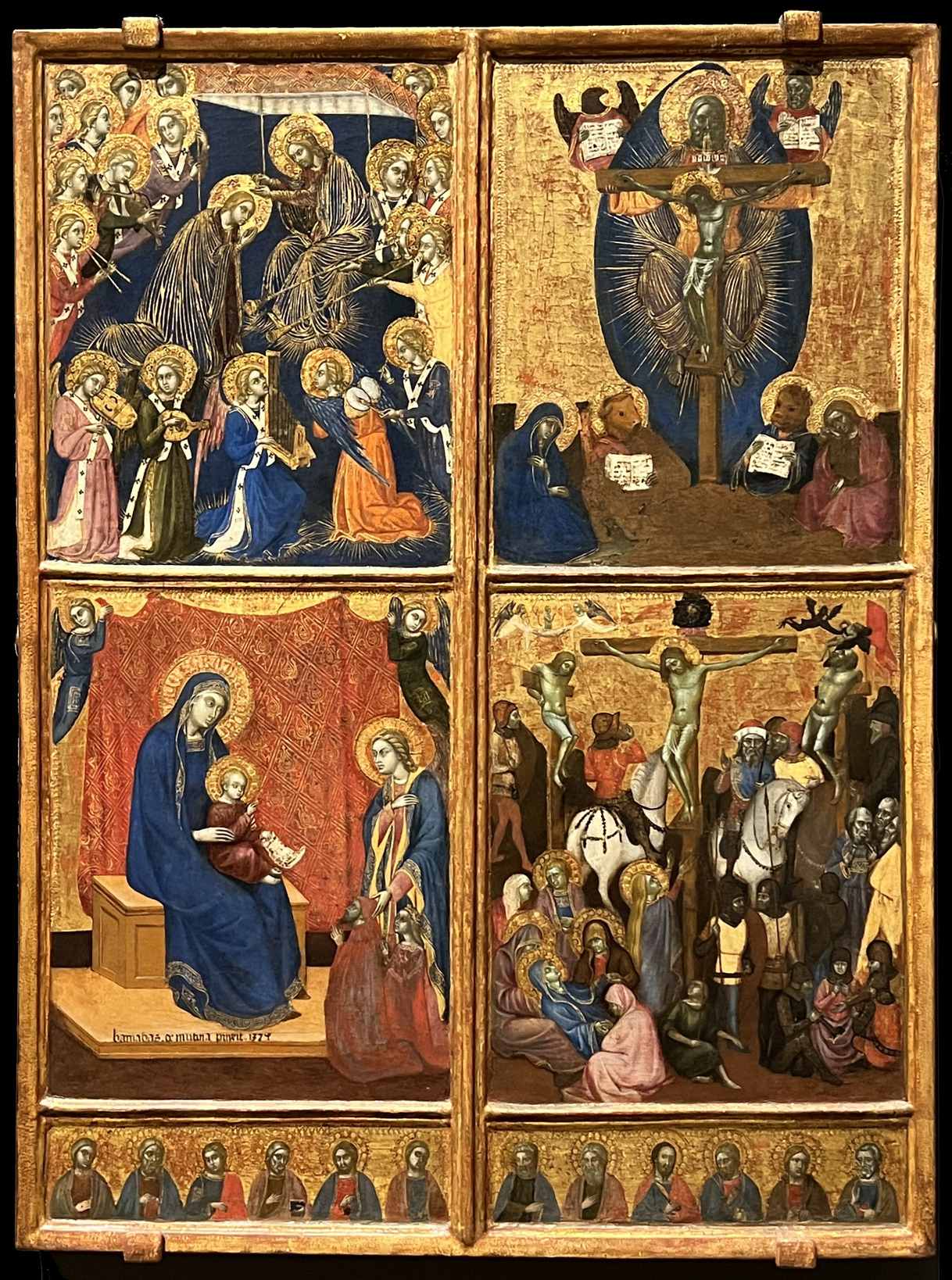
Barnaba da Modena — Scenes of the Virgin; The Trinity; The Crucifixion, 1374
In the lower left scene, the Archangel Raphael presents two donors to the Virgin and Child. The woman wearing the crown might be the first owner of this work, which was probably joined to two or three other panels. Above, Christ crowns his mother Queen of Heaven. On the right, a busy Crucifixion scene is set below a Trinity (God the Father, Son and Holy Ghost) surrounded by symbols of the Four Evangelists.
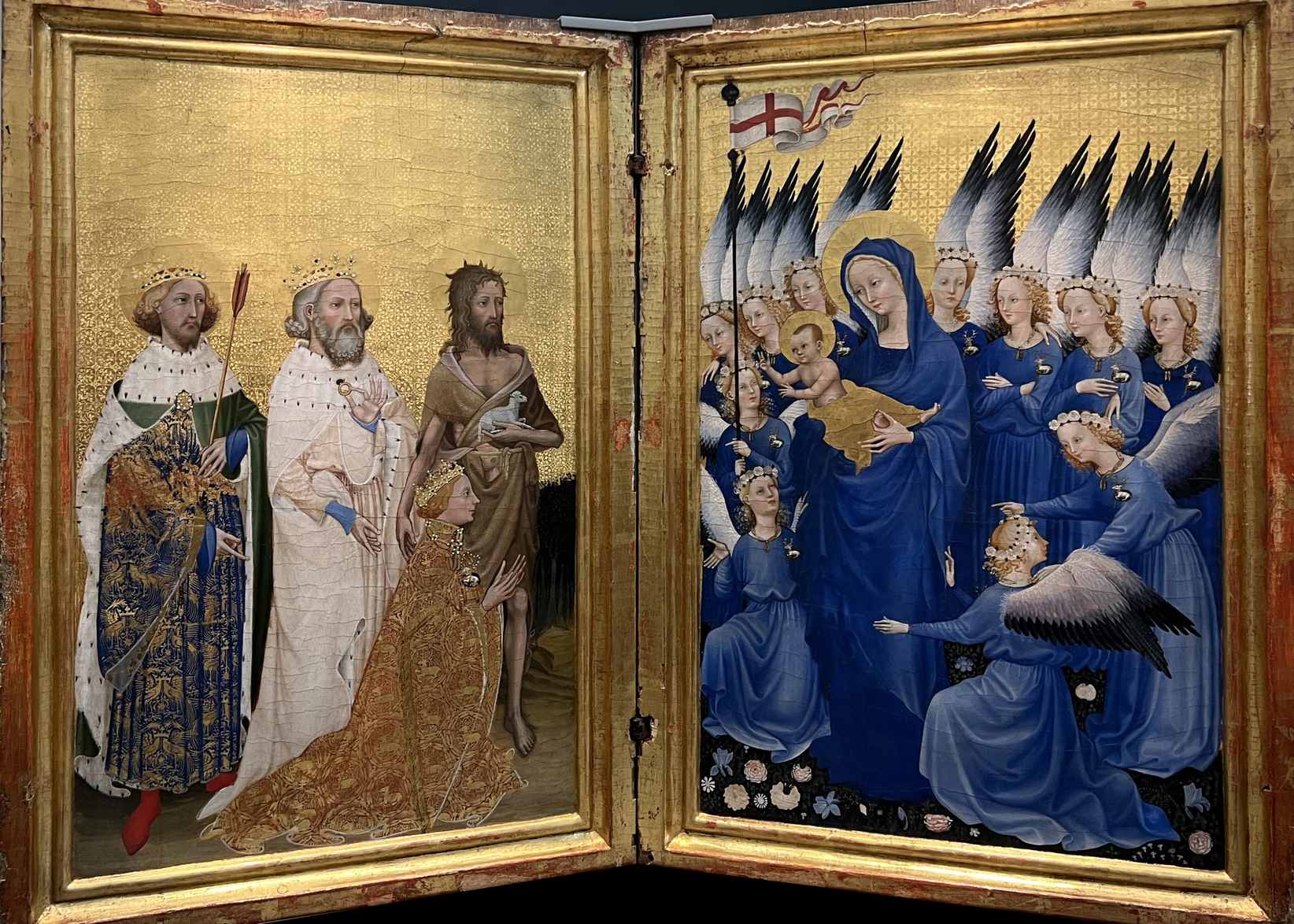
English or French painter — The Wilton Diptych, about 1395-9
This shimmering diptych was made for the private devotion of Richard II (born 1367), King of England from 1377 to 1399. The youthful king is introduced to the Virgin and Child by Saint John the Baptist and two of England's patron saints, Edward the Confessor and Edmund. Clad in deep blue robes, the angelic retinue wears Richard's emblem of the white hart. The richness of the pigments and treatment of the gold surface are unmatched. The painter's identity and geographical origins remain a mystery.
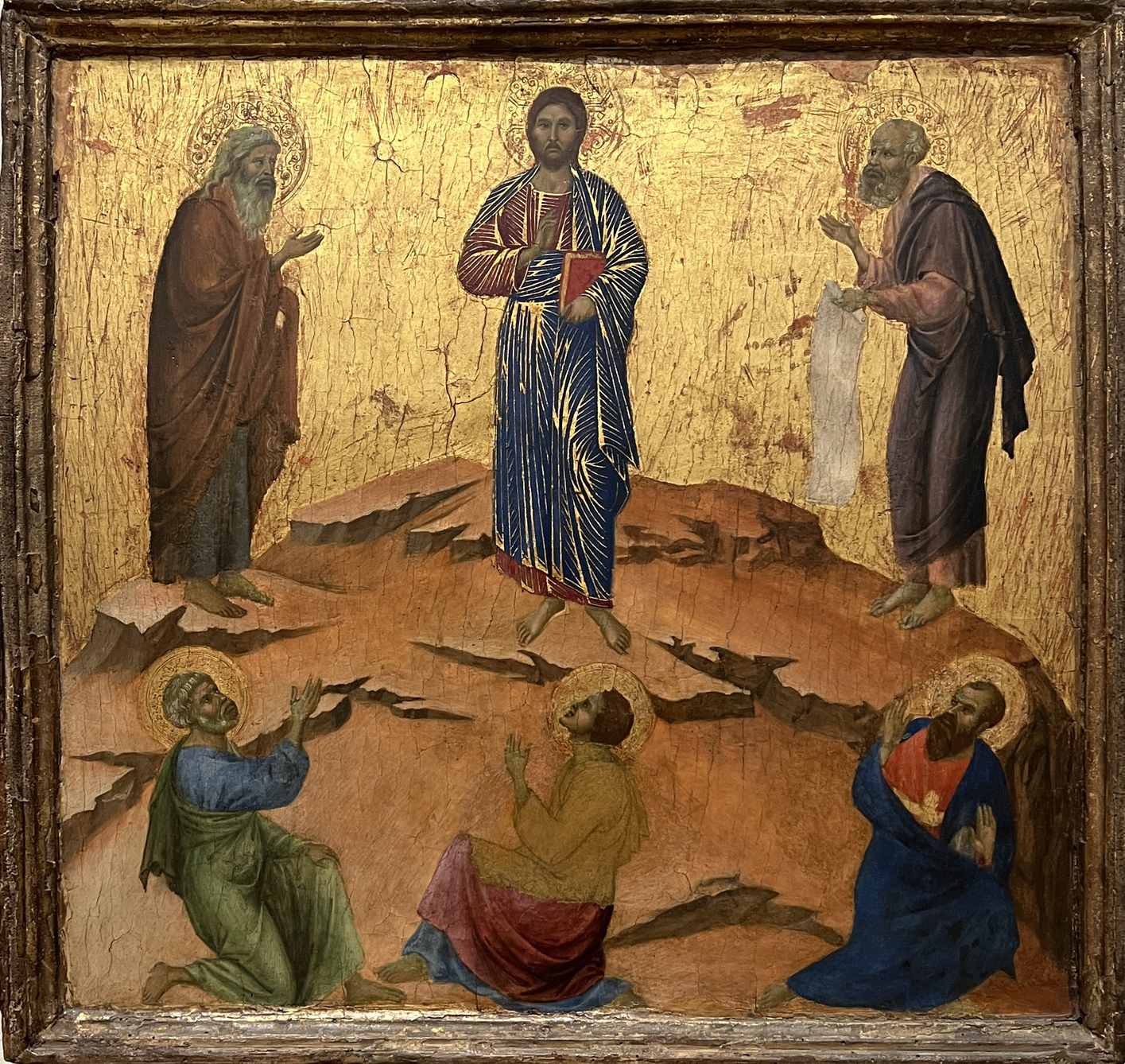
Duccio — Maestà Predella Panels, 1307/8-11
A tiny dove descends in a heavenly sphere as the Archangel Gabriel tells the Virgin Mary she will give birth to the son of God. The Virgin recoils and pulls her cloak around herself. The miracle of Christ's conception is represented by gold striations (stripes) in her red dress. Christ rubs mud and spit into the eyes of the man born blind. The man miraculously sees for the first time after washing his eyes in the fountain. His astonished gaze turns towards the transfigured Christ in the next panel. Gold striations on Christ's clothing indicate his shining divinity as he talks with the prophets Moses and Elijah.
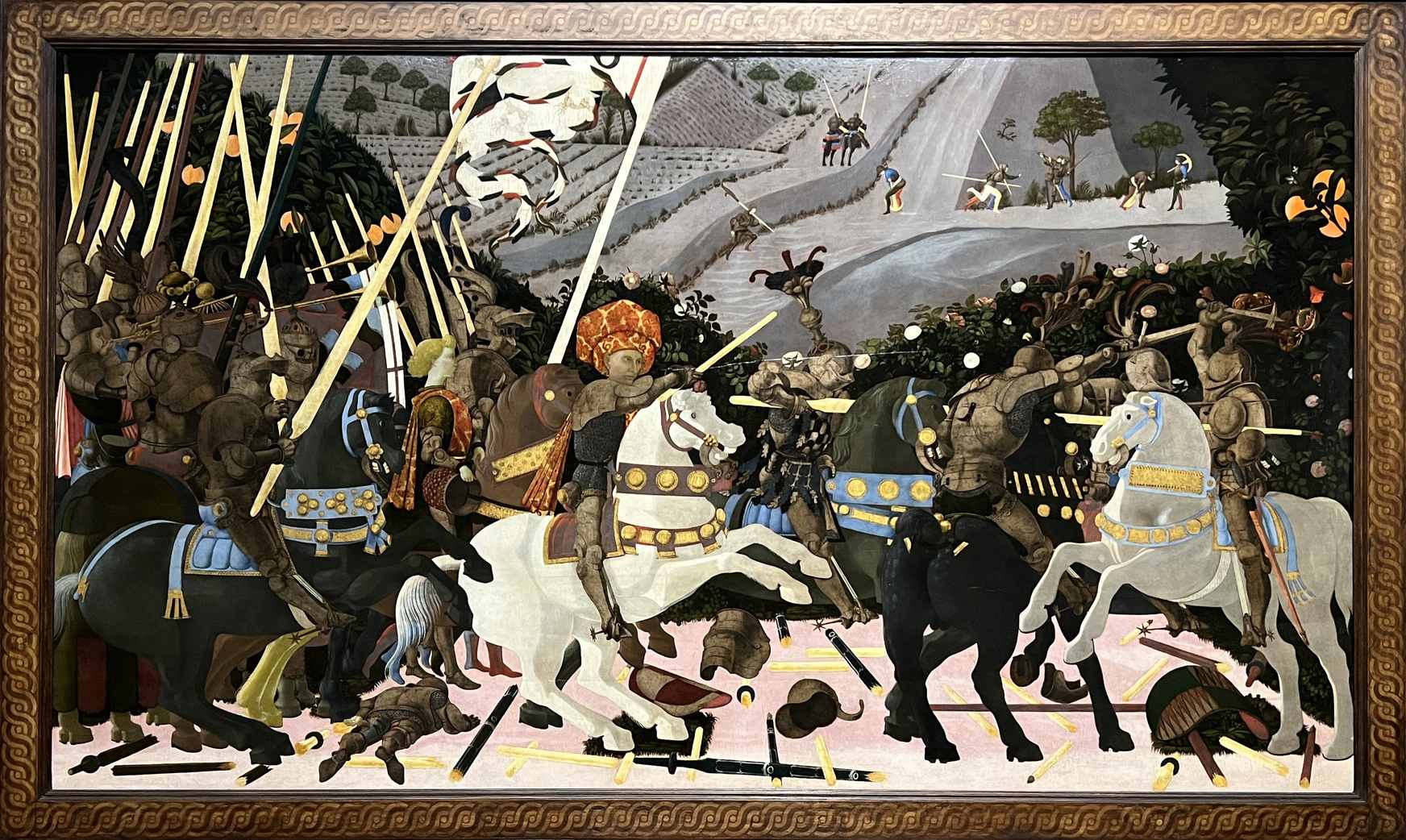
Paolo Uccello — The Battle of San Romano, probably about 1438-40
Niccolò da Tolentino (about 1350-1435), leader of the Florentine army, rides a white horse into the thick of battle. This is one of three paintings by Uccello to commemorate his victory. In around 1484, the painting was forcibly acquired from its first owners by Lorenzo de' Medici. The panel originally had an arched top, which was cut off to allow it to be hung in the Palazzo Medici in Florence.
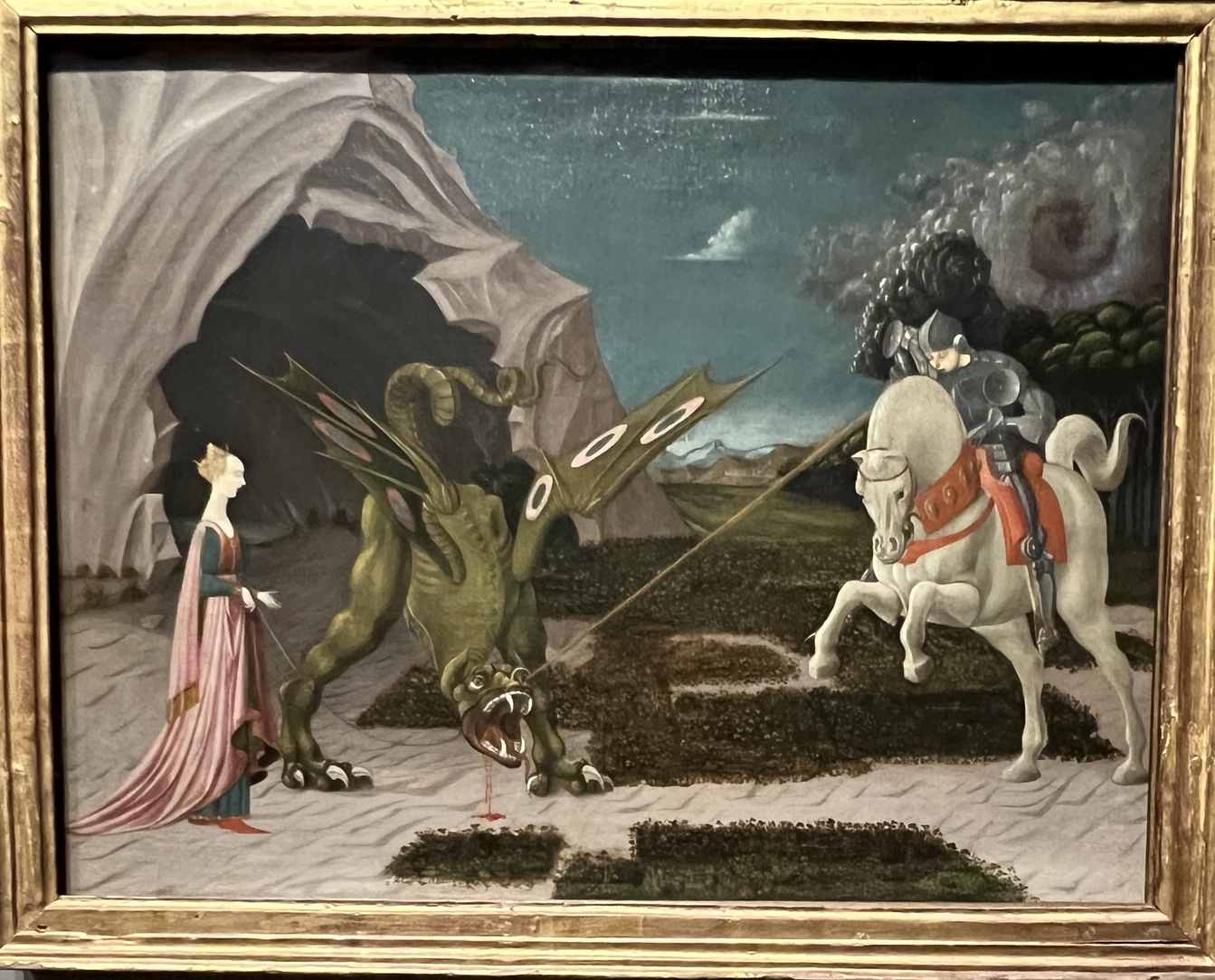
Paolo Uccello — Saint George and the Dragon, about 1470
This is one of the earliest paintings on canvas in the National Gallery. Before a dark cave, Saint George plunges his lance into the eye of a formidable dragon. As storm clouds gather, a crescent moon lights up the sky. Anticipating the next moment in the story, the princess has already tamed the dragon and tied her belt around its neck. This small painting may have been intended for a domestic space like a bedroom.
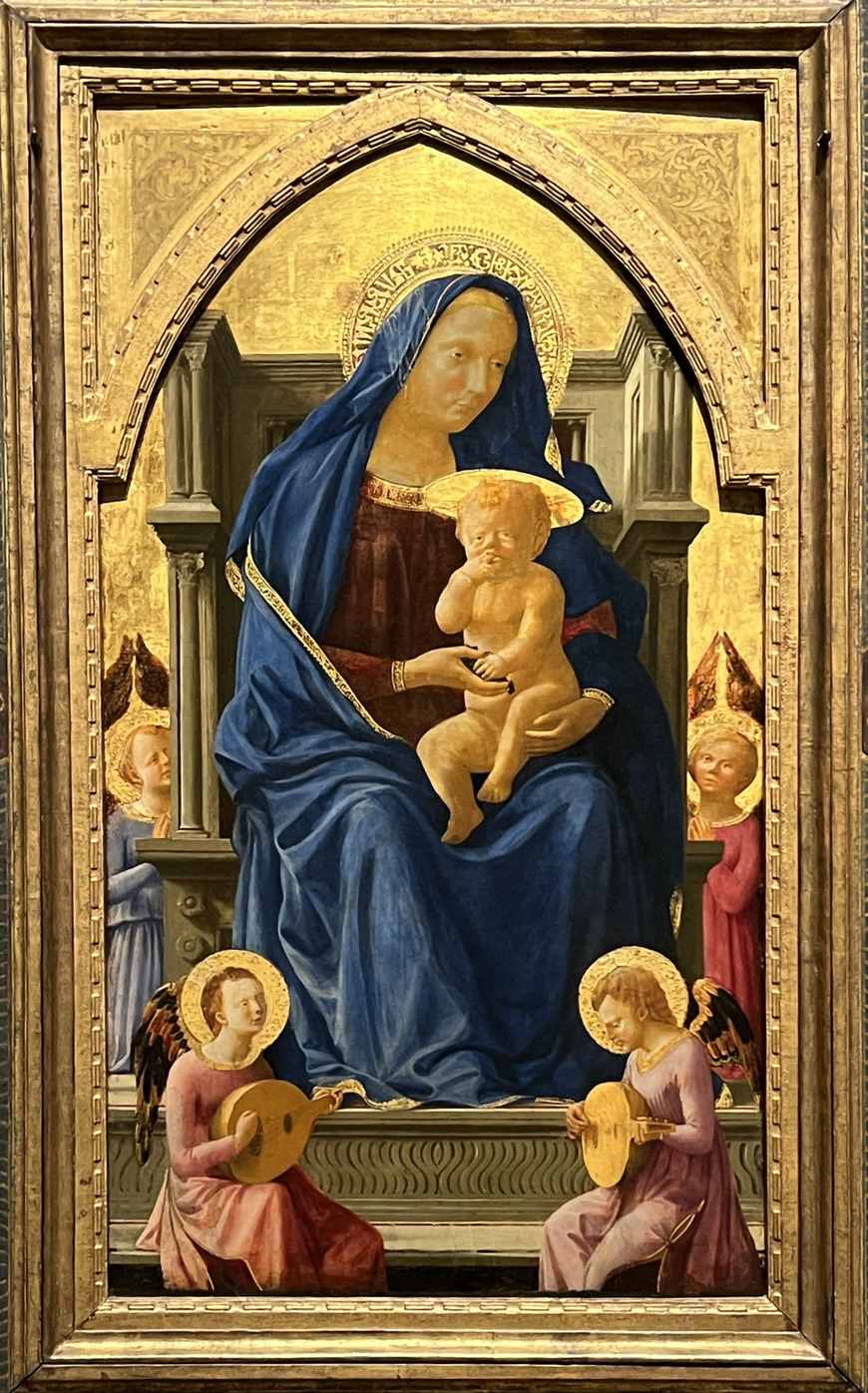
Masaccio — The Virgin and Child, 1426
This panel was the centre of the altarpiece Masaccio painted for Santa Maria del Carmine, Pisa. The Virgin's halo is decorated with pseudo-Arabic text. This was derived from inscriptions found on Islamic metalwork and textiles. Such objects were widely collected in Masaccio's native Florence and prized for their preciousness and beauty. They became associated with the Church, often appropriated for use during the Mass. Their religious value was heightened because they came from places mentioned in the Bible.
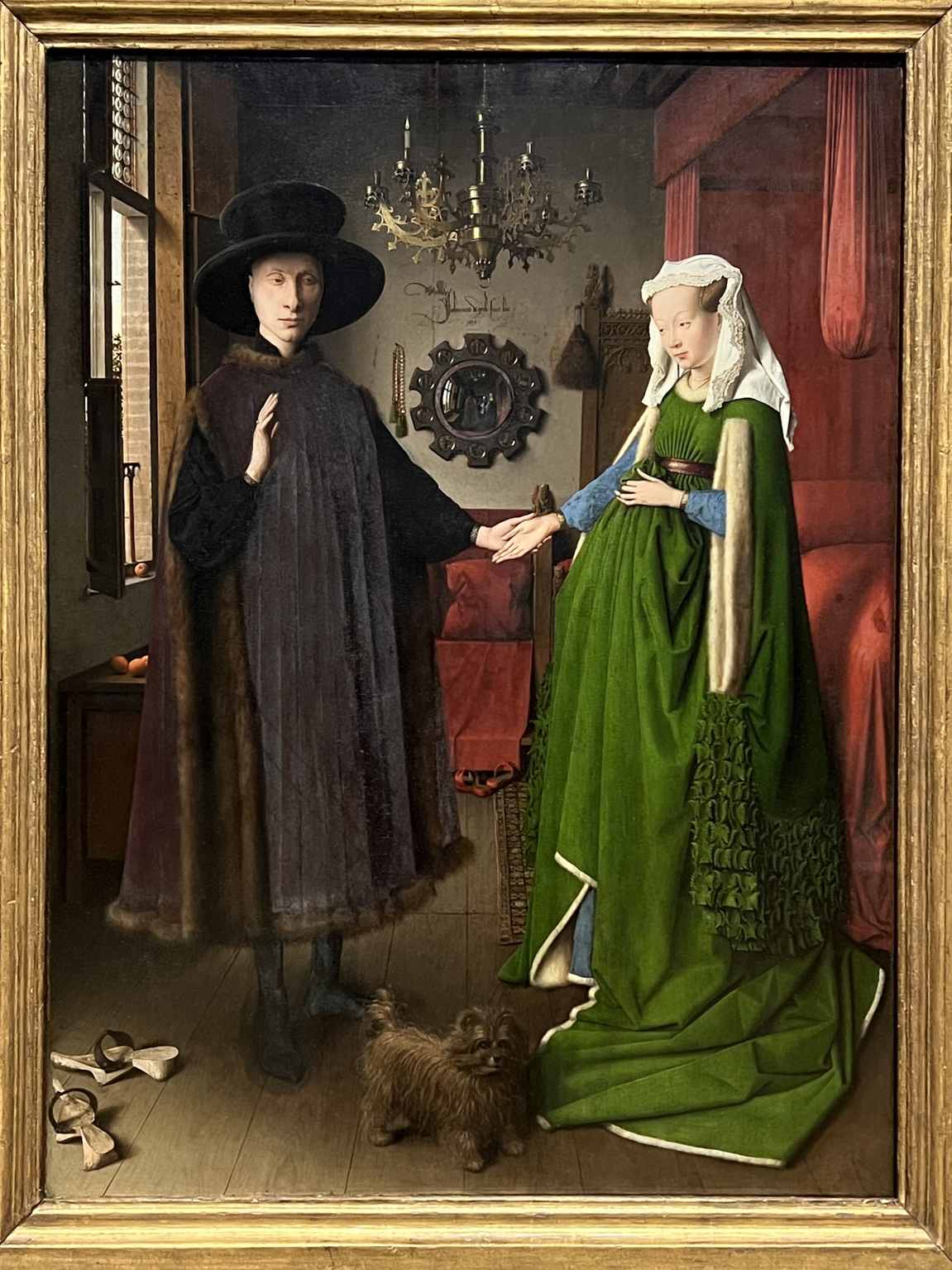
Jan van Eyck — The Arnolfini Portrait, 1434
This is one of the most famous paintings in European art, and one of the most elusive. The couple portrayed belong to the Arnolfini family, a rich Italian merchant dynasty based in Bruges. Van Eyck created an exceptionally complex setting for his sitters. Shown full-length in their bedchamber, surrounded by objects that proclaim their wealth, they greet both us and the visitors reflected in the mirror on the back wall. Van Eyck signed his skilful illusion: 'Jan van Eyck was here'.
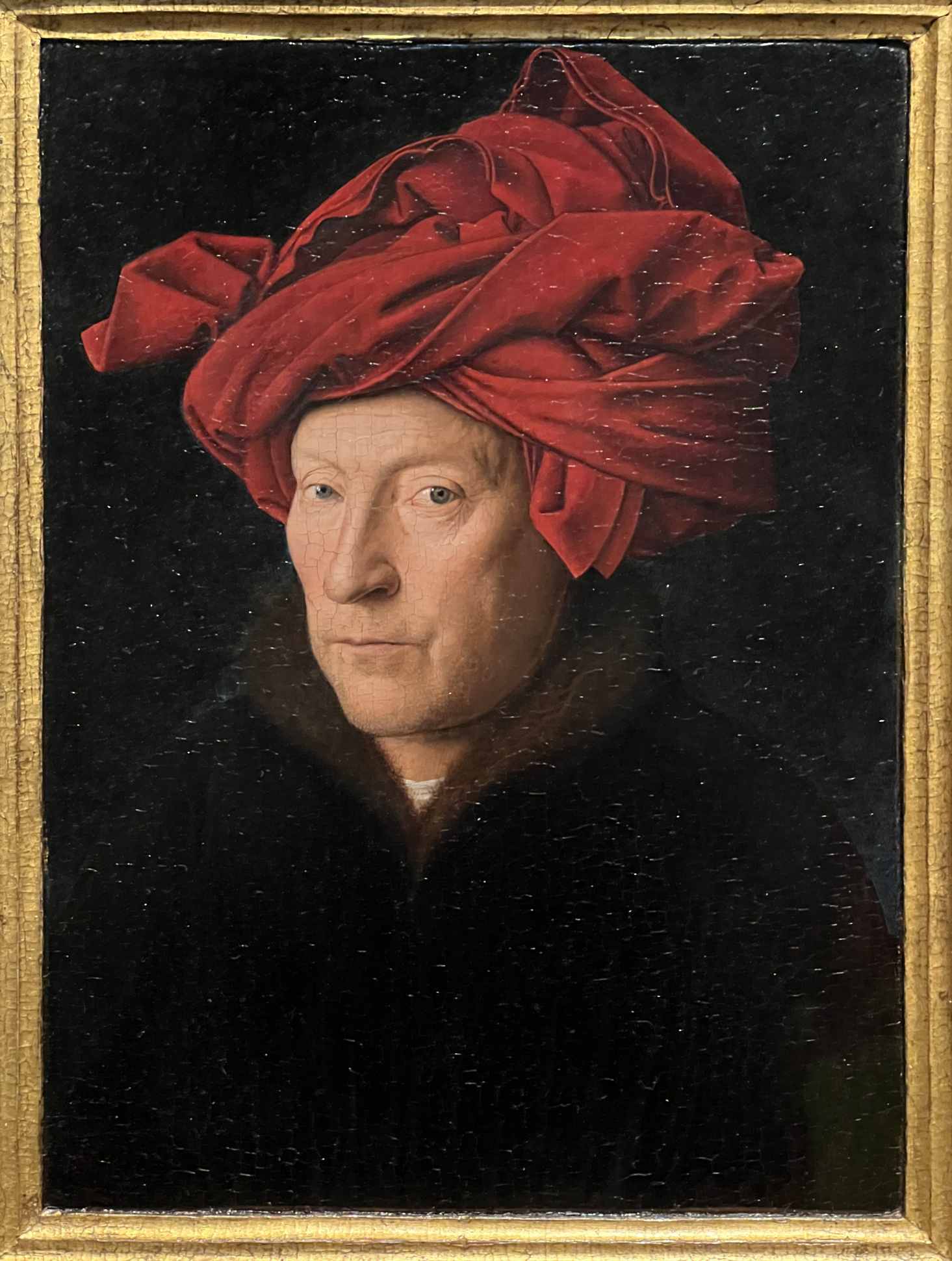
Jan van Eyck — Portrait of a Man (Self Portrait?), 1433
This may be the earliest self portrait in the history of European painting. Jan van Eyck signed and dated it on the lower edge of the original frame, while proudly inscribing his motto, 'As I can', along the top. Whoever the sitter is, he looks out intently at us, his acute gaze framed by fine wrinkles. His stubble seems to grow before our very eyes. His flamboyantly draped red headpiece steals the show.
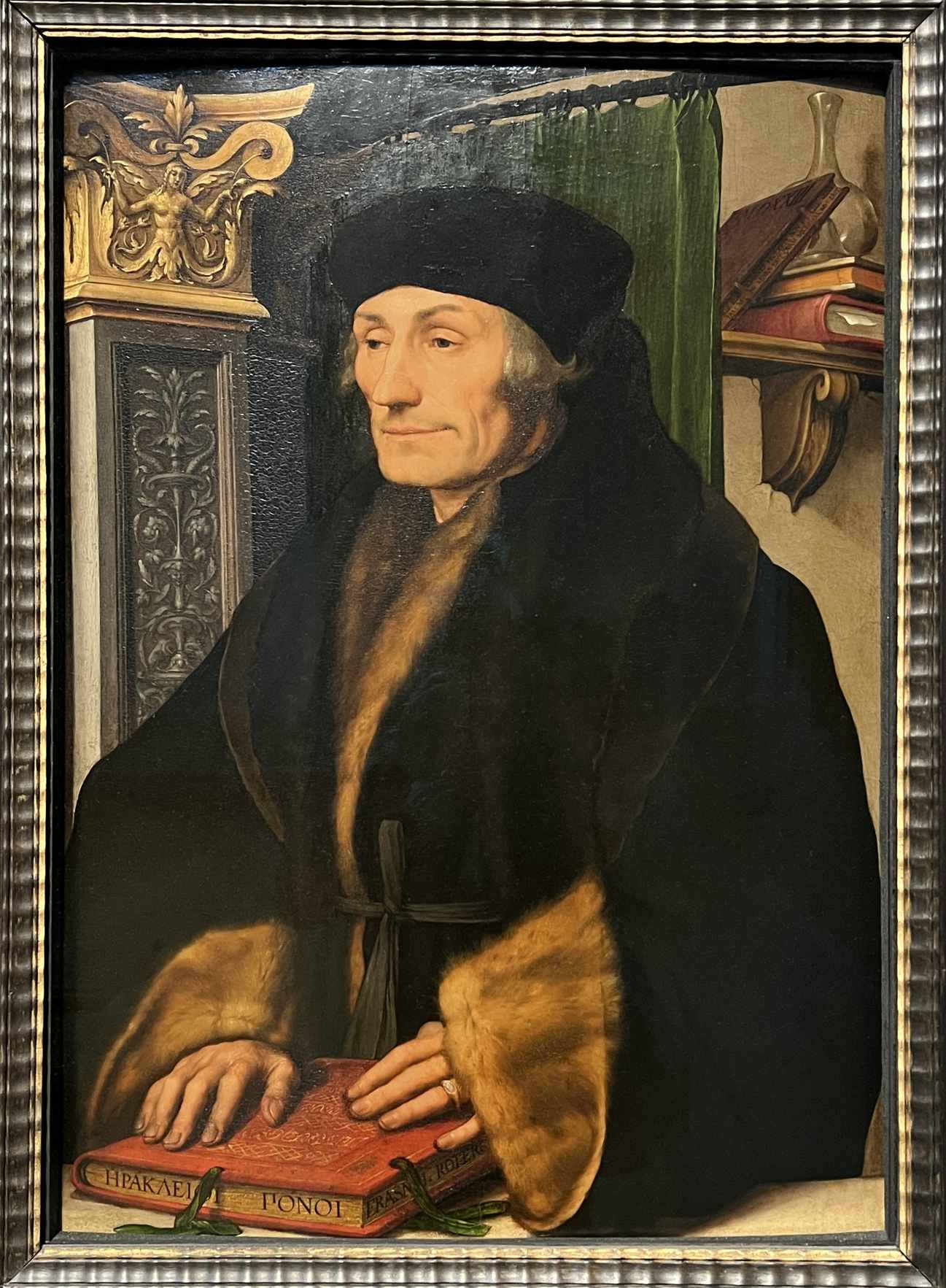
Hans Holbein the Younger — Erasmus, 1523
This is the most accomplished portrait ever painted of Erasmus of Rotterdam (1466-1536), the great humanist of the Northern Renaissance. It is probably the picture Erasmus sent to his patron the Archbishop of Canterbury, William Warham (about 1450-1532), as 'a little piece of Erasmus'. Holbein presents his sitter as the prince of scholars, surrounded by books. The artist self-confidently states on the edge of a book on the shelf: 'I am Hans Holbein, whom it is easier to denigrate than to emulate.'
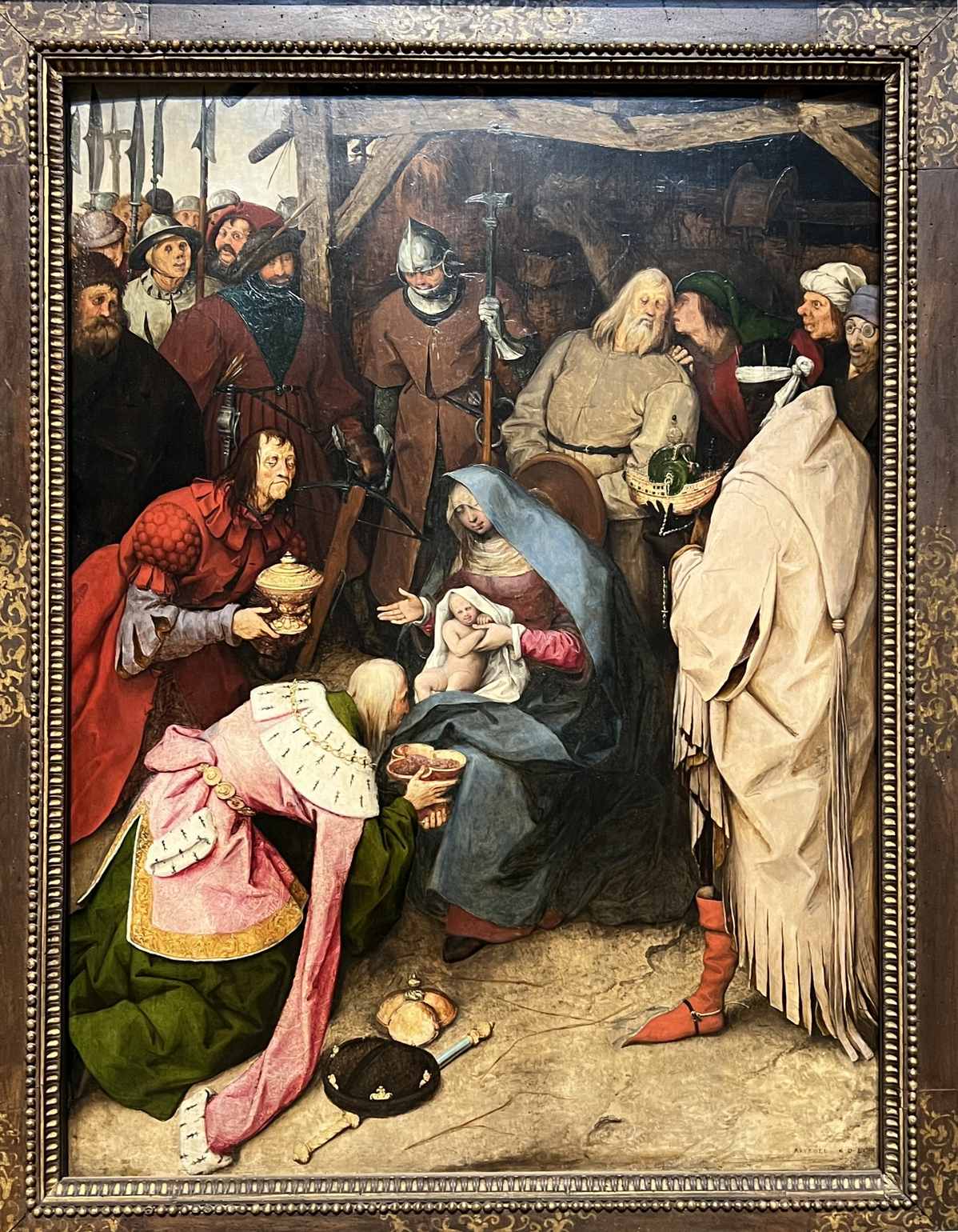
Pieter Bruegel the Elder — The Adoration of the Kings, 1564
The threat of imminent violence is everywhere in this painting. Bruegel's Kings look exhausted after their journey, unlike the stately monarchs usually depicted in this biblical scene. The Christ Child recoils from them. Heavily armed men crowd around the holy family, their halberds creating an ominous rhythm. They recall the mercenaries hired to repress Protestant uprisings, who were sowing destruction across the Low Countries at the time.
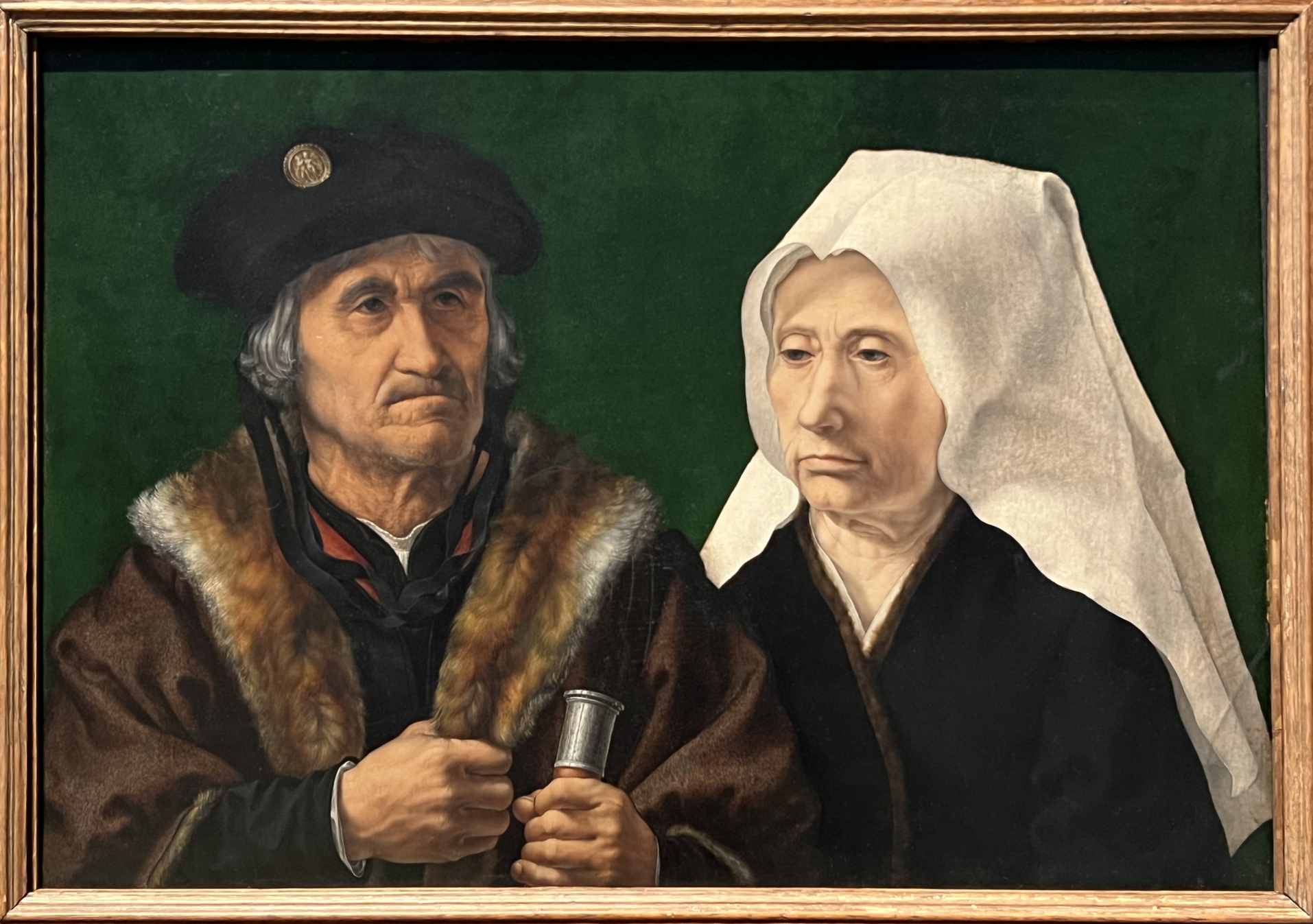
Jan Gossaert (Jean Gossart) — An Elderly Couple, about 1520
This is an uncompromising depiction of old age. Lost in thought, these elderly sitters look neither at us nor at each other. The man clenches his jaw and holds his staff tightly, but fallen white hairs on his collar betray his frailty. Gossart painted this work on parchment, its smooth surface enabling him to capture countless details.
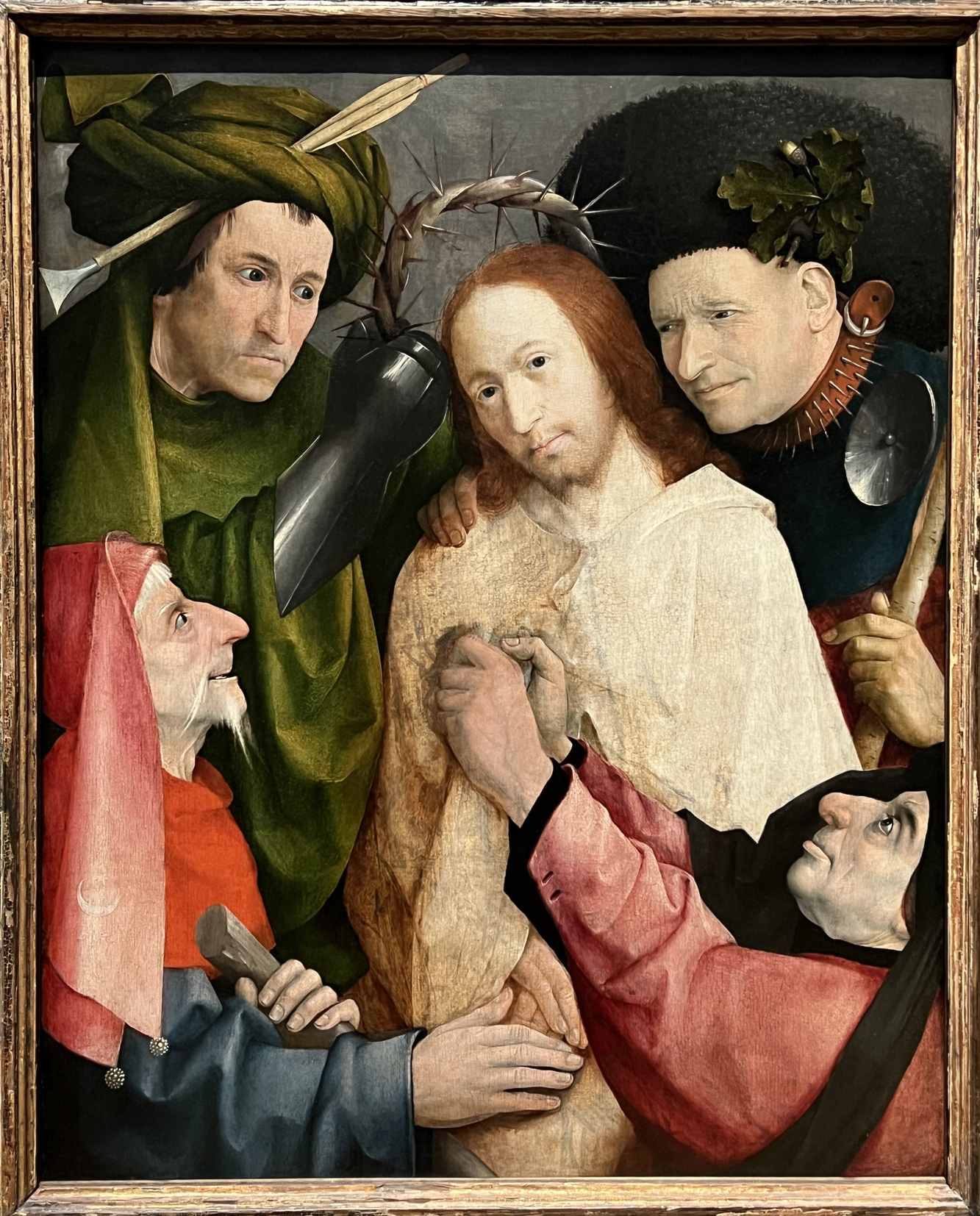
Hieronymus Bosch — Christ Mocked (The Crowning with Thorns), about 1510
Bosch is best known for his nightmarish landscapes but in this disturbing scene he demonstrates his skill at crafting psychological drama. Four tormentors cram tightly around Christ. One places the crown of thorns on his head. Suspended in space, it looks like a halo. Carrying hunting equipment such as a dog collar and arrow, the men hound their victim. Christ's serene expression contrasts with their brutal features. He looks out to us hauntingly, making us passive witnesses to his suffering.
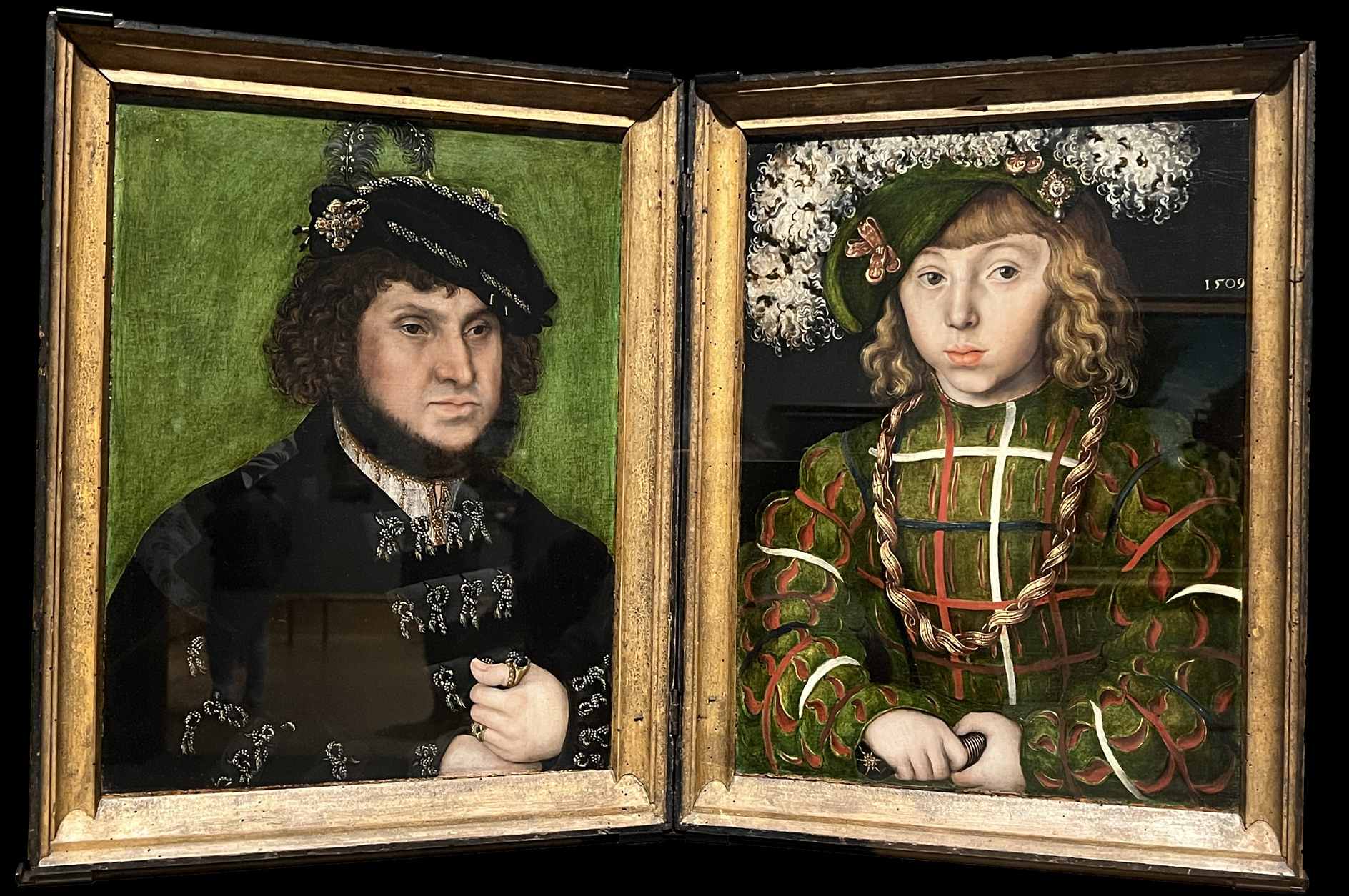
Lucas Cranach the Elder — Diptych: Two Electors of Saxony, 1509
While diptychs of couples were common during the Renaissance, this one is unusual. It portrays the ruler of Saxony, Johann the Steadfast (1468-1532), and his heir Johann Friedrich the Magnanimous (1503-1554). The hinged format emphasises the bond between father and son, as does the reversed colour scheme of green and black. The six-year-old boy is presented with great freshness, dominating the composition as the ruler he will one day become.
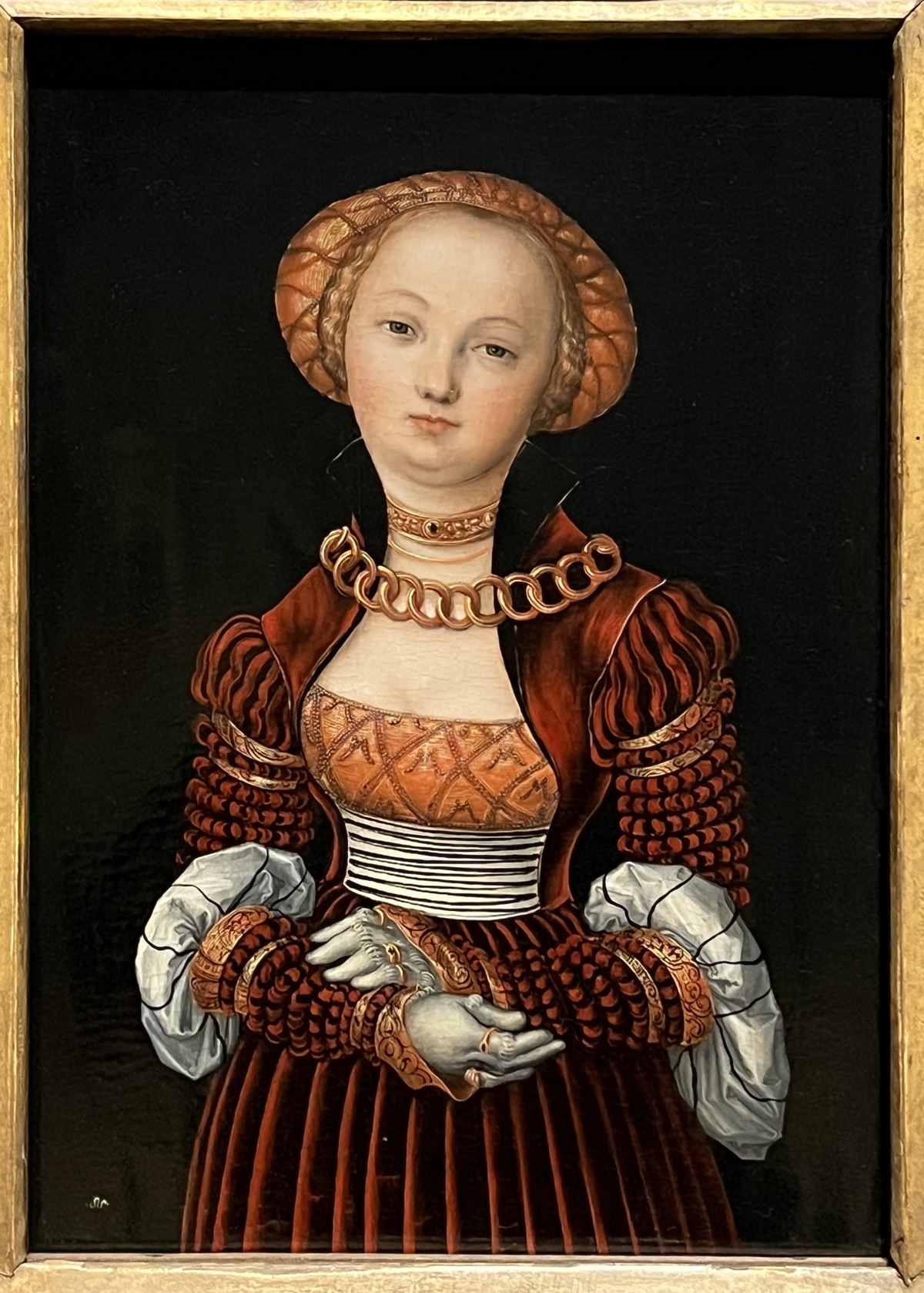
Lucas Cranach the Elder — Portrait of a Woman, 1525-7
Cranach was a gifted portraitist with a highly individual style that proved attractive to patrons. This young woman's fiery red dress and sumptuous jewellery were fashionable at the Saxon court. The letter 'M' embroidered on her bodice might be a clue to her identity. While her features are idealised, her pose and direct gaze are intense and alluring.
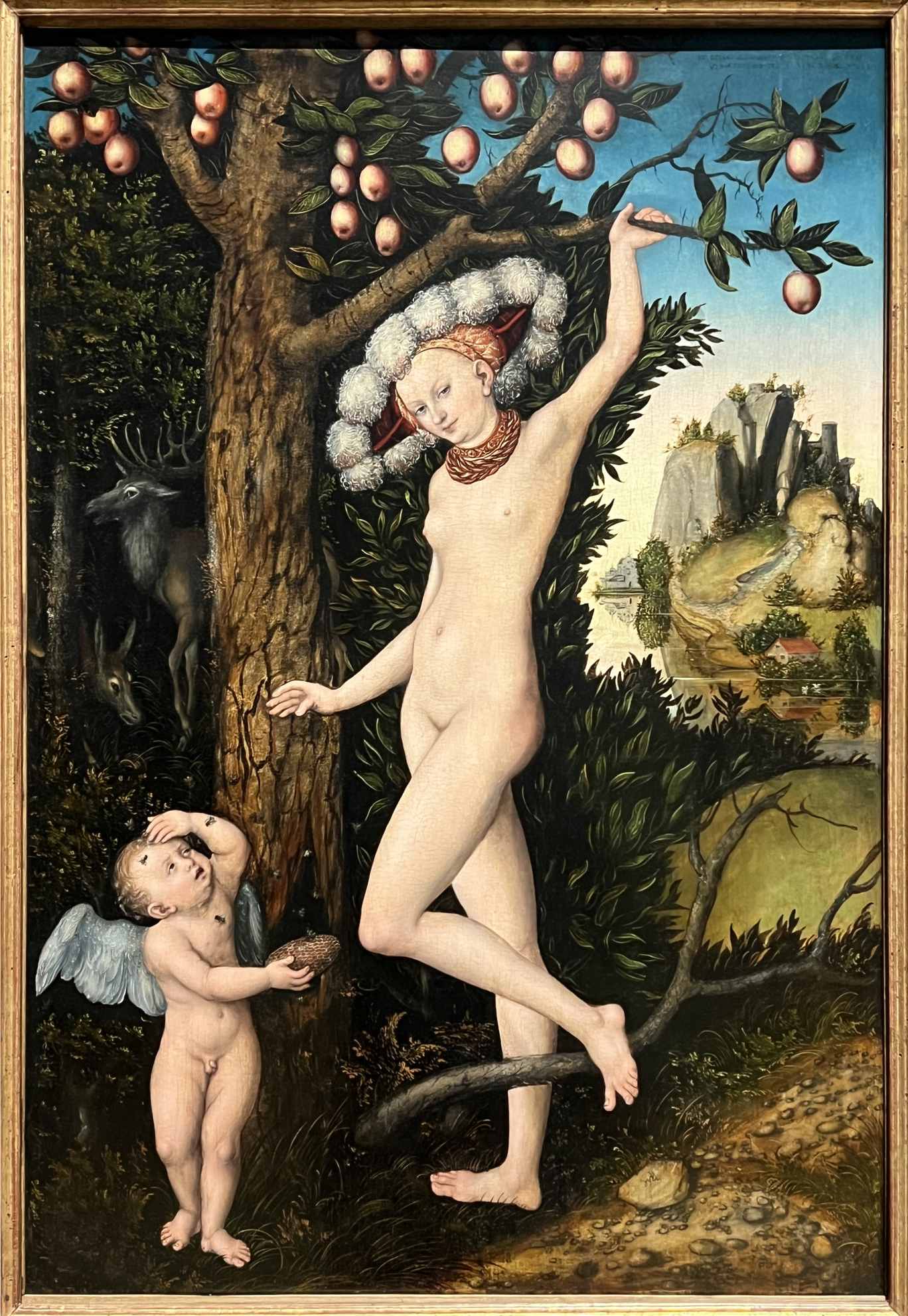
Lucas Cranach the Elder — Cupid complaining to Venus, 1526-7
Cranach depicts an ancient Greek tale revived during the Renaissance. Having stolen honeycomb, Cupid is stung by bees. His mother Venus compares his plight to the love he inspires with his arrows: sweet like honey but invariably followed by pain. With her rich plumed hat, jewelled choker and provocative gaze, Venus resembles a beauty from the Saxon court rather than a classical goddess.
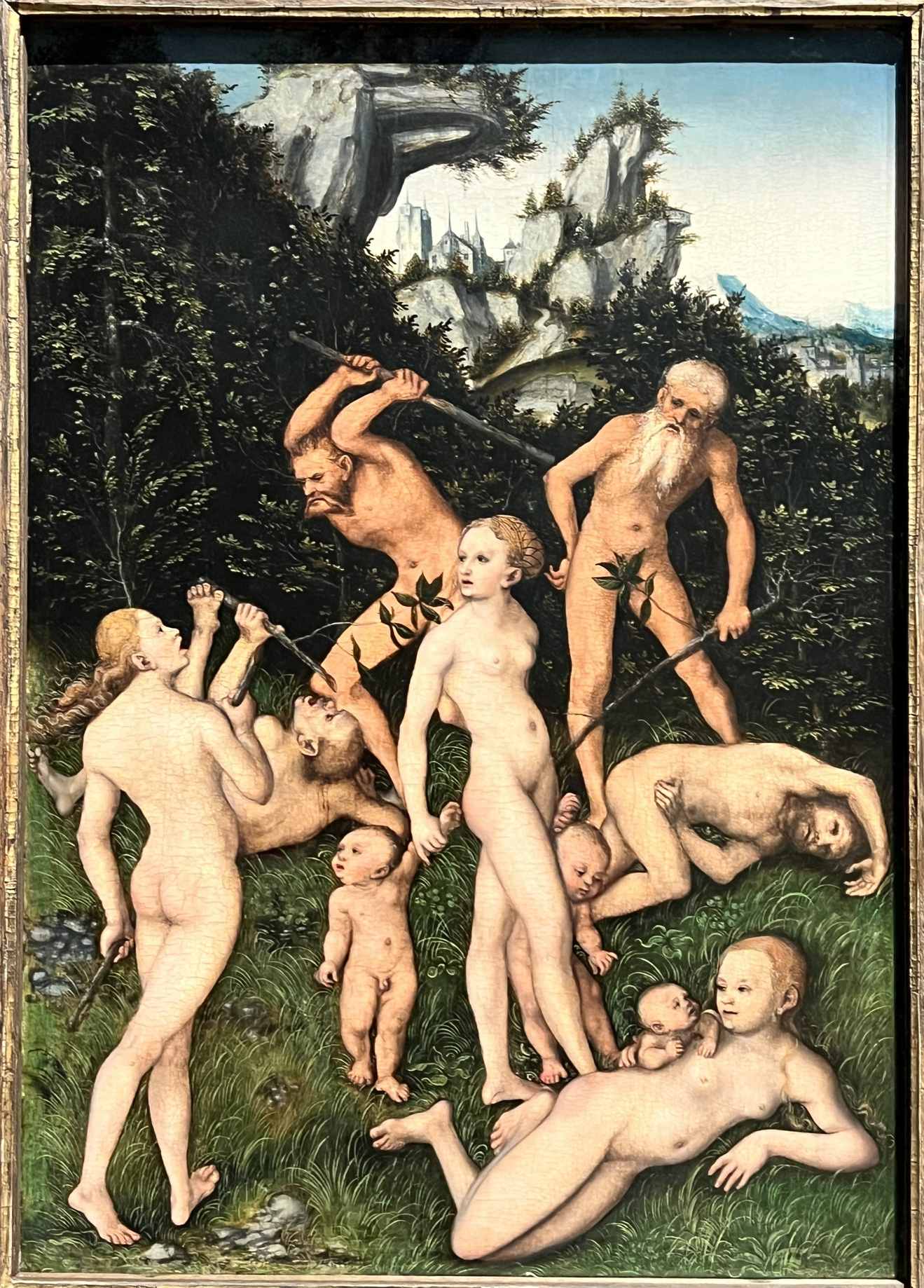
Lucas Cranach the Elder — Primitive People, 1527-30
Renaissance thinkers took interest in ancient Greek myths tracing humanity's origins through a succession of ages marked by increasing violence. Cranach imagined these early societies in an untamed wilderness in which peoples close to nature gave free rein to their instincts. He set the scene in the local wooded landscape where his patrons enjoyed hunting.
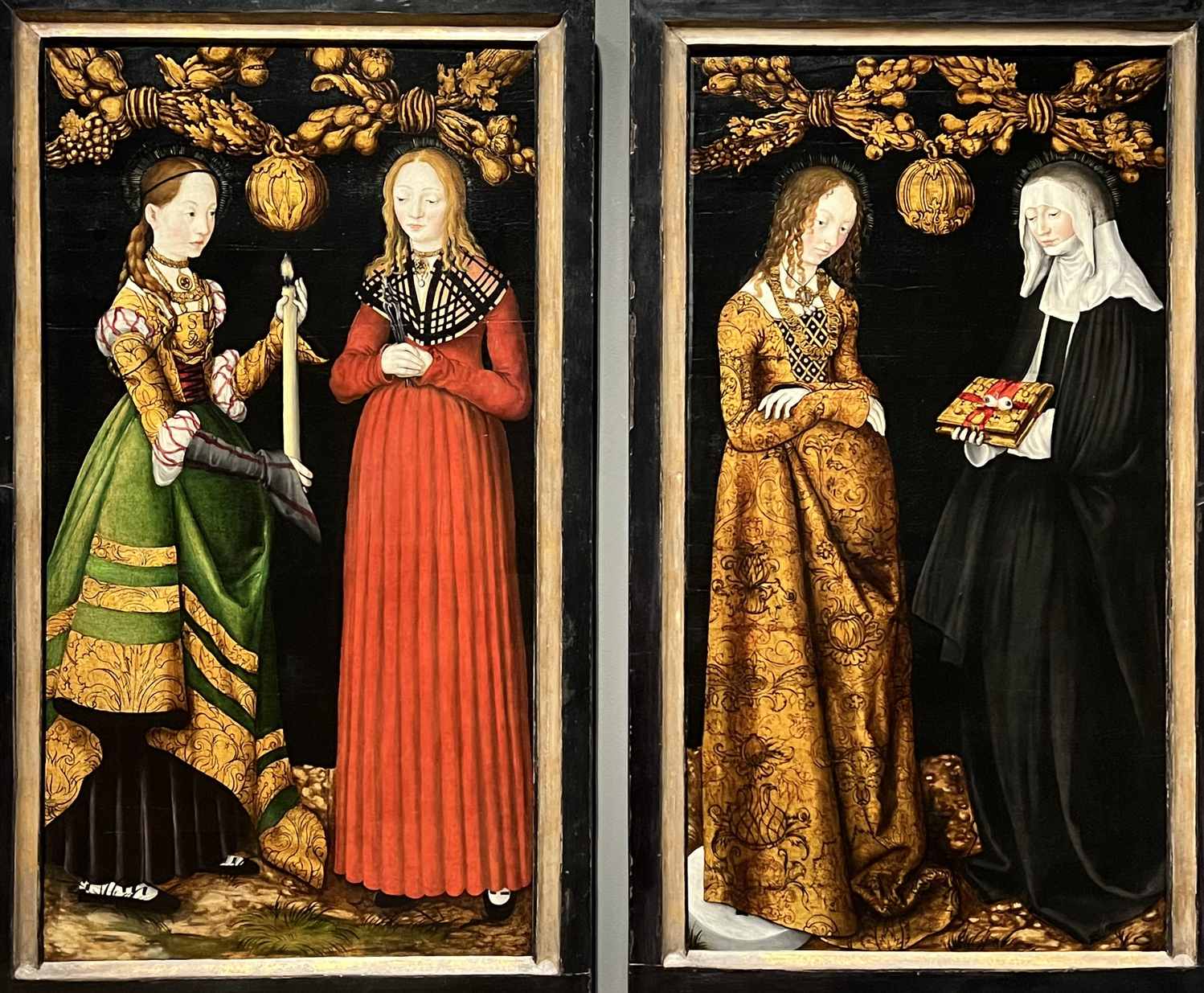
Lucas Cranach the Elder — The St Catherine Altarpiece: Reverses of Shutters, 1506
These pictures once formed the exterior wings of an altarpiece dedicated to Saint Catherine (now Gemäldegalerie Alte Meister, Dresden). It was commissioned by Frederick the Wise (1463-1525), Elector of Saxony. The saints would have been visible when the altarpiece was closed (on most days of the year) and are identified by their attributes – objects from their legends. They are Genevieve and Apollonia, and Christina and Ottilia. Cranach depicted these early Christian saints in contemporary dress so viewers could more easily relate to them.
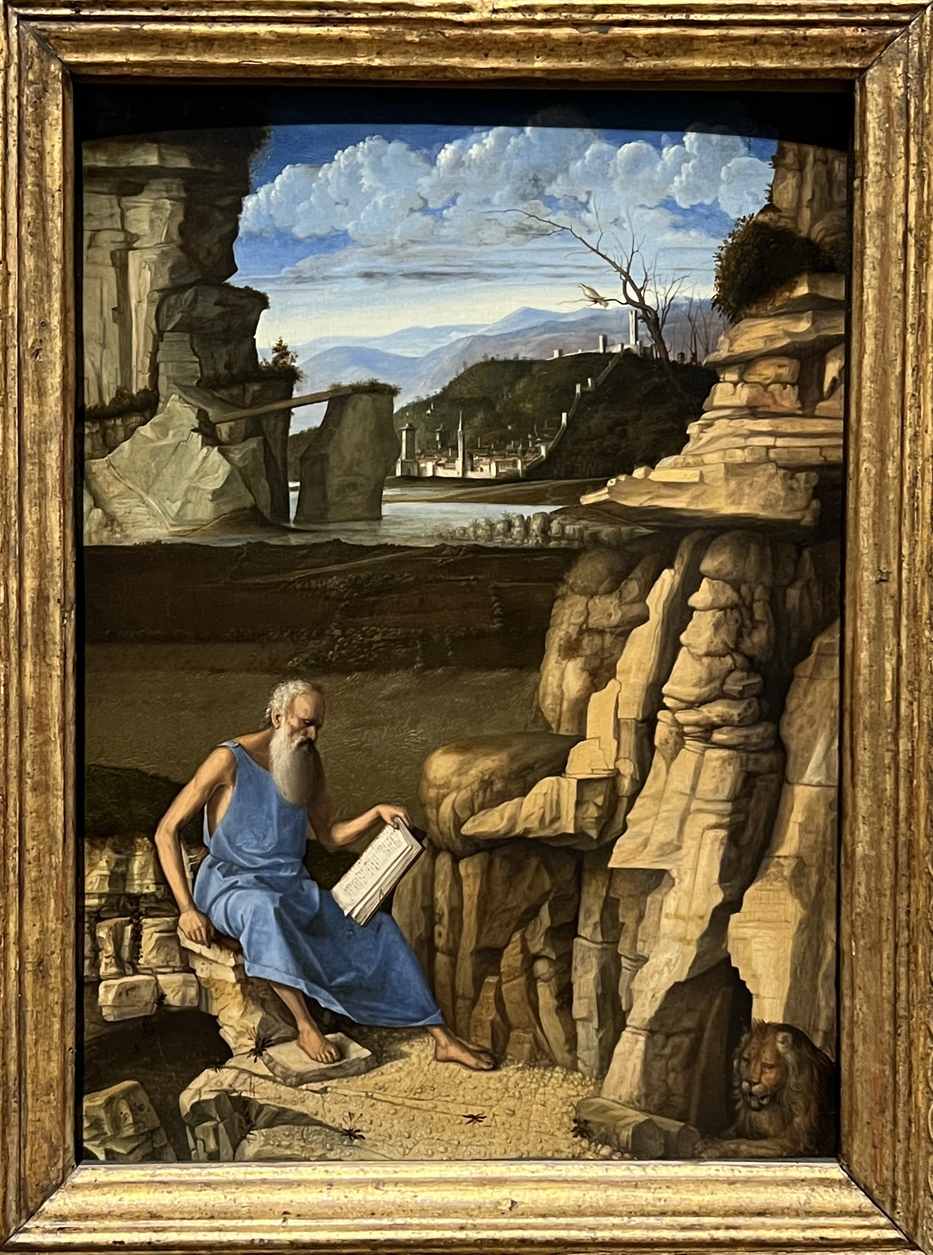
Giovanni Bellini — Saint Jerome reading in a Landscape, about 1480-5
Saint Jerome is shown in harmony with the wilderness around him. His peaceful mood is reflected in the idyllic landscape. Bellini's precise depiction of the natural world would have encouraged viewers to contemplate God's creation. The distant city takes inspiration from real places in the Veneto, including the town of Marostica. The prominent surrounding wall emphasises the saintly hermit's seclusion. Bellini suggests the distance of the far-away hills by using shades of hazy blue – a technique known as aerial perspective.
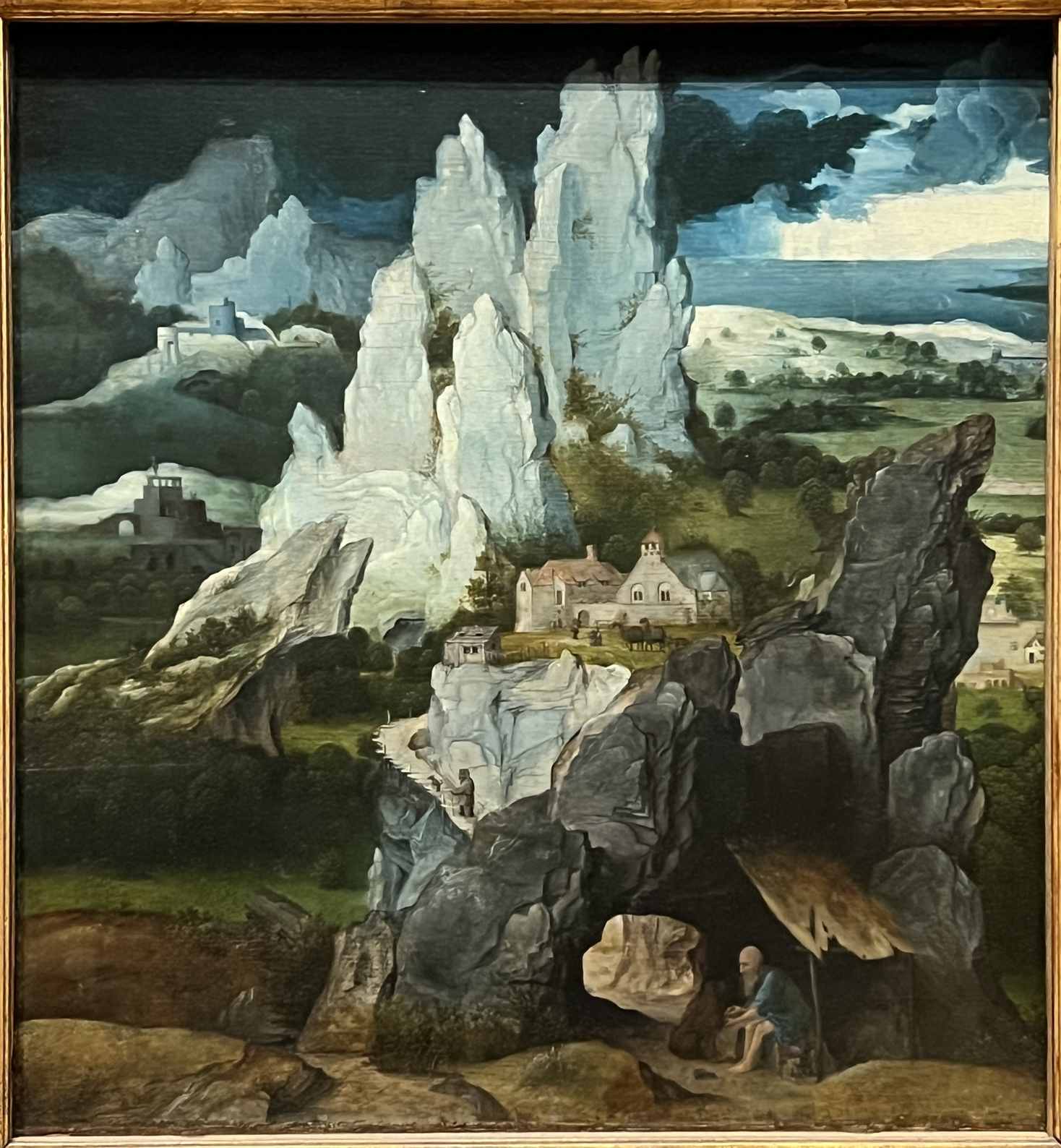
Workshop of Joachim Patinir — Saint Jerome in a Rocky Landscape, about 1515
Overshadowed by towering rocks, Saint Jerome removes a thorn from a lion's paw. With its high viewpoint and sweeping vista, this painting is characteristic of the popular 'World Landscape' tradition that emerged in the Netherlands during the early 16th century. These dramatic settings gave a new prominence to the landscape, often dominating the small figures populating them.
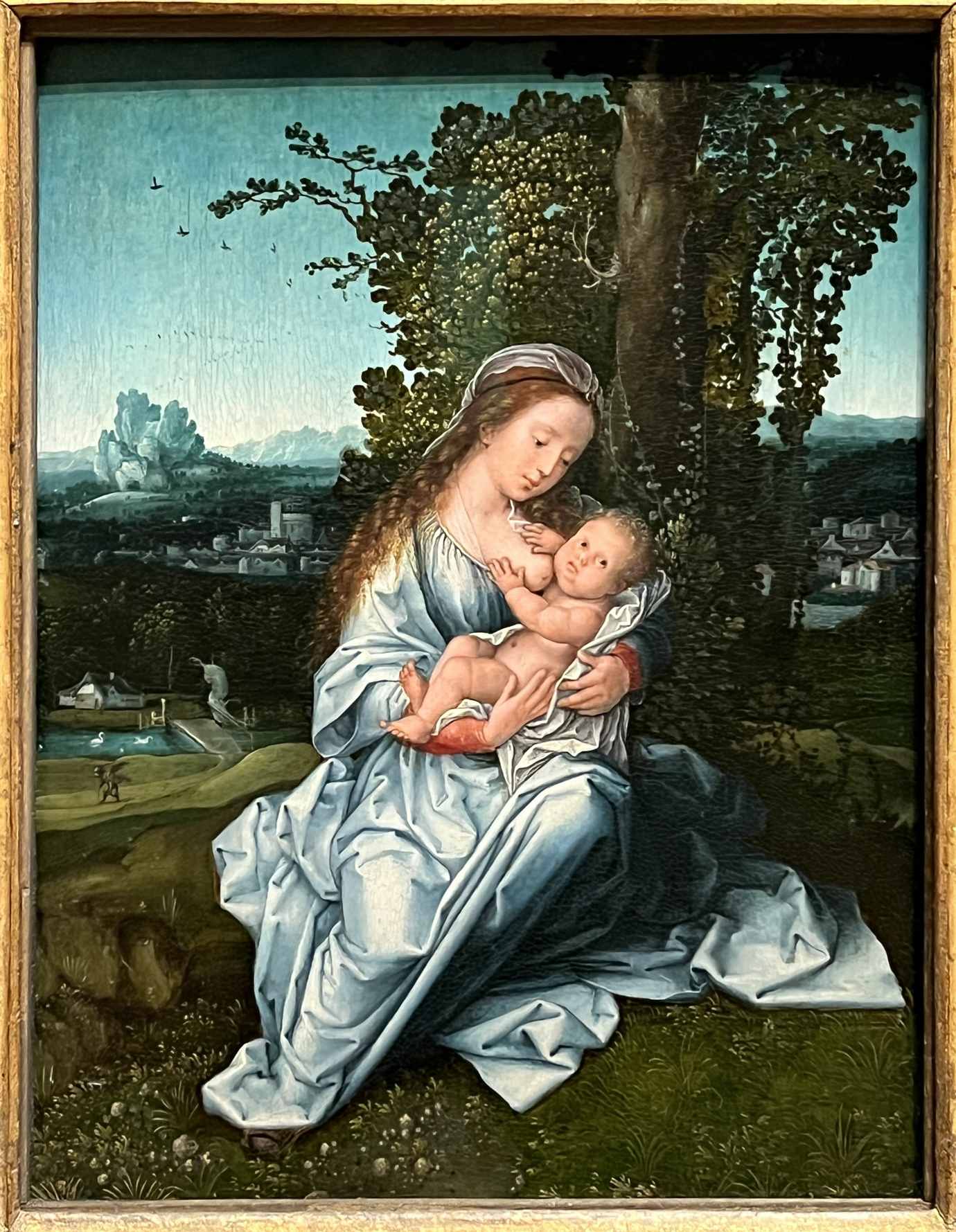
Bernaert van Orley — The Virgin and Child in a Landscape, about 1525
This painting reflects the growing division of labour in Netherlandish workshops at the turn of the 16th century. While the lively Virgin and Child are by Van Orley, the landscape may have been painted by an artist specialising in such work. Executed with speed and assurance, it appears to have been done first, with space left for the figures to be added afterwards.
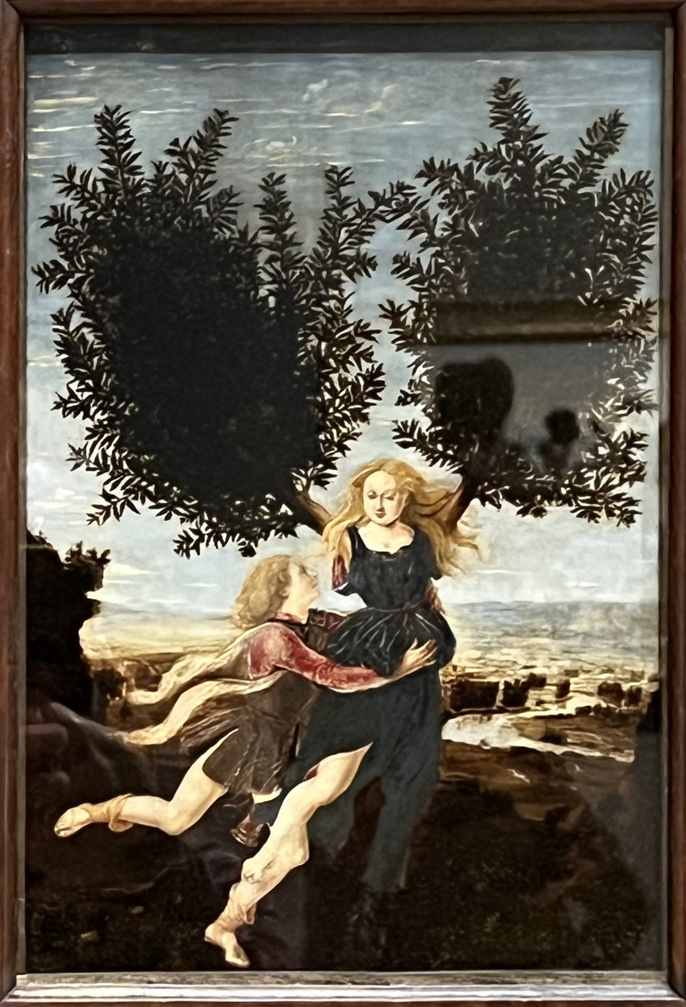
Piero del Pollaiuolo — Apollo and Daphne, probably 1470-80
In the Metamorphoses, the Roman poet Ovid recounted how Apollo fell in love with the nymph Daphne. She fled, and just as Apollo caught her, she was turned into a laurel tree. Pollaiuolo set this mythical scene in his native Tuscan countryside. The painting's minute details suggest it was made to be admired close-up.
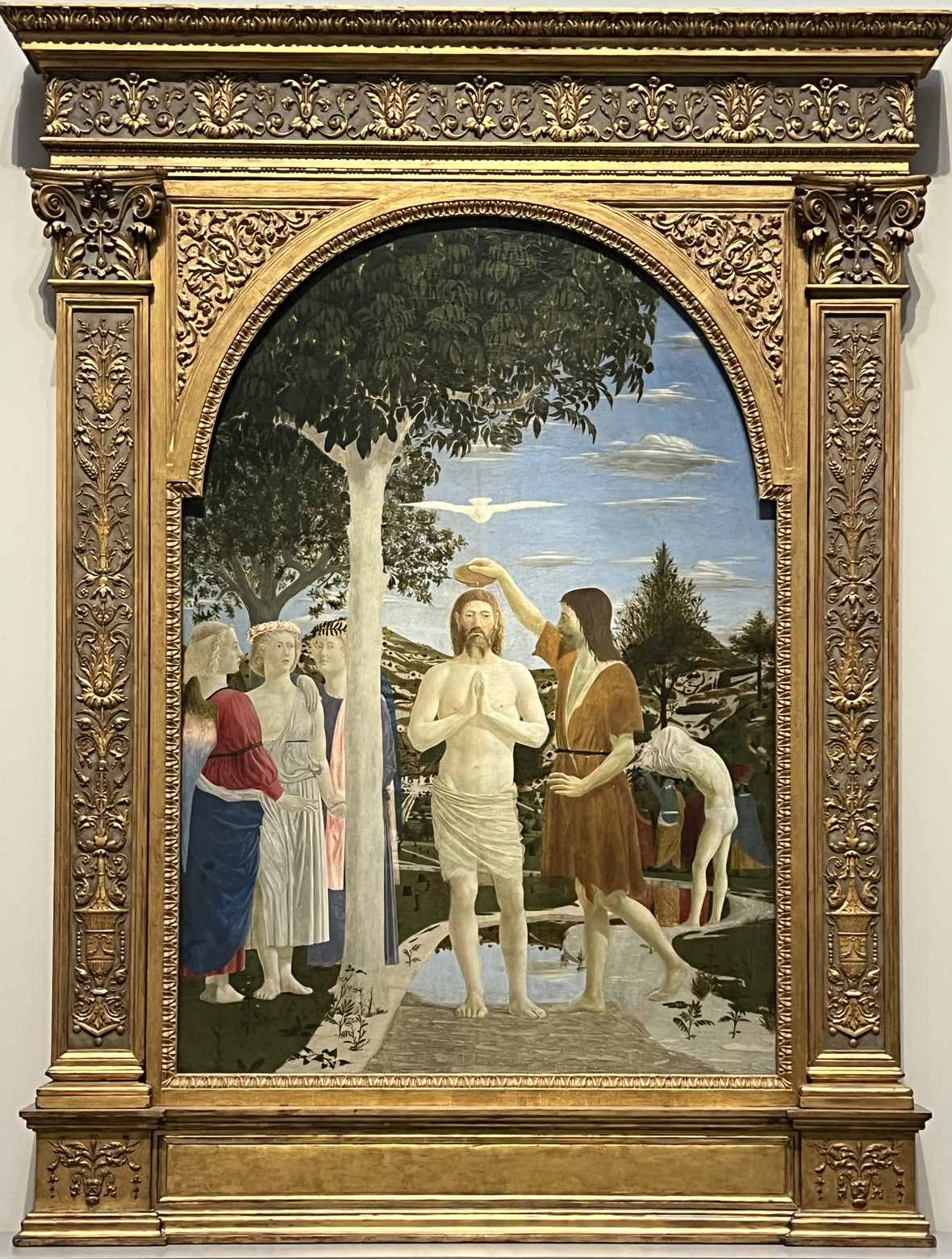
Piero della Francesca — The Baptism of Christ, probably about 1437-1445
Piero set the river Jordan, where Christ was baptised, in the hilly terrain of his native Tuscany. He ordered the composition according to mathematical principles, using a grid structure as a guide for the placement and scale of objects. As a result, the figures appear to inhabit the landscape very naturally, creating a feeling of great balance and calm. The men in Byzantine hats may represent the Kings from the east, whose visit to the new-born Christ is celebrated on the same date as the Baptism.
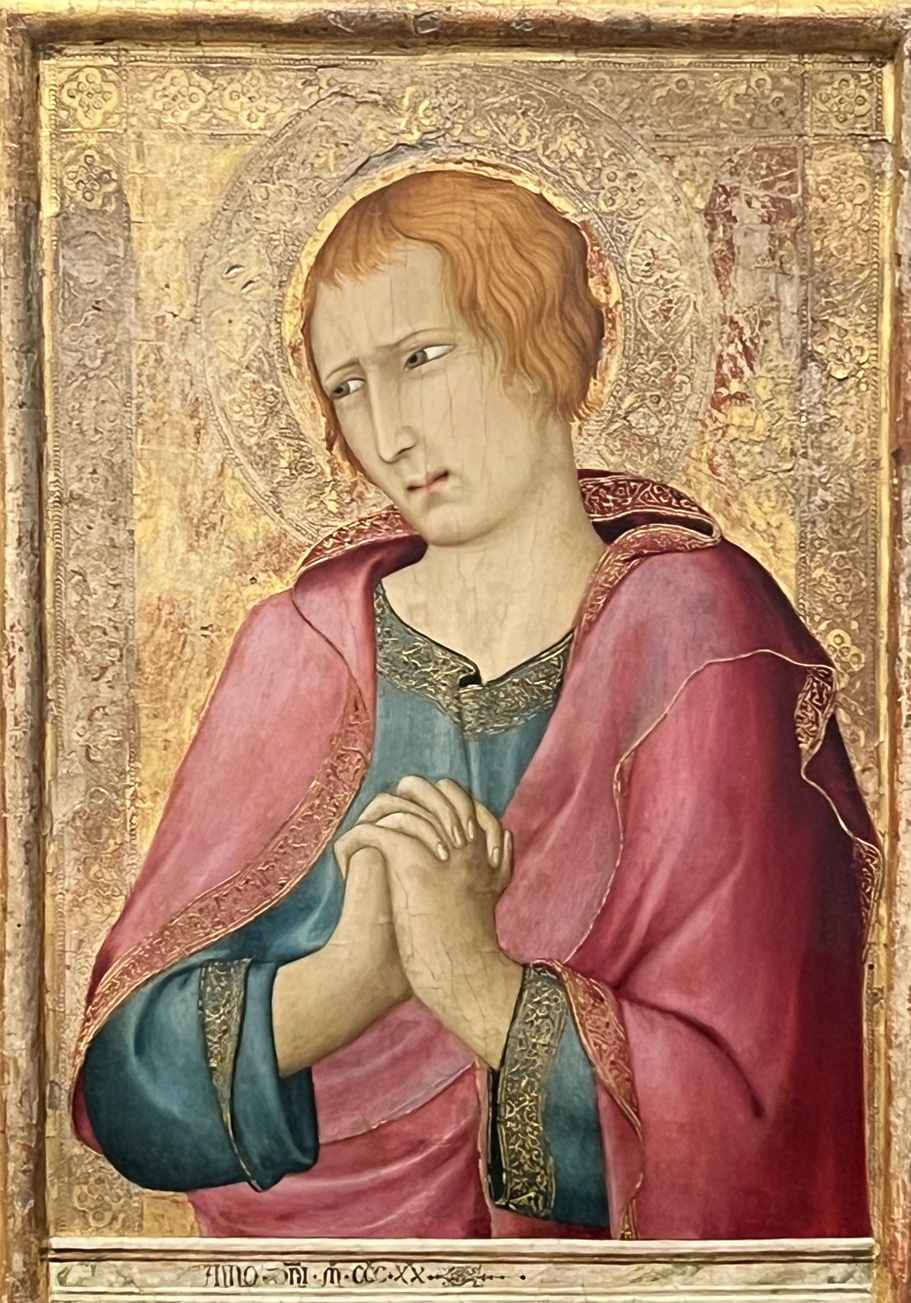
Simone Martini — Saint John the Evangelist, 1320
After Duccio's death, Simone Martini became Siena's principal painter. His work is known for its technical brilliance and splendid decorative effects. His paintings also include remarkably subtle depictions of human emotions. This panel once formed part of a devotional triptych (a three-panelled altarpiece). Saint John tenses his jaw and narrows his eyes in grief. His pose suggests that he originally looked toward a central image of the dead Christ. As John clasps his hands, his garments ripple around him, echoing the intensity of his sorrow.
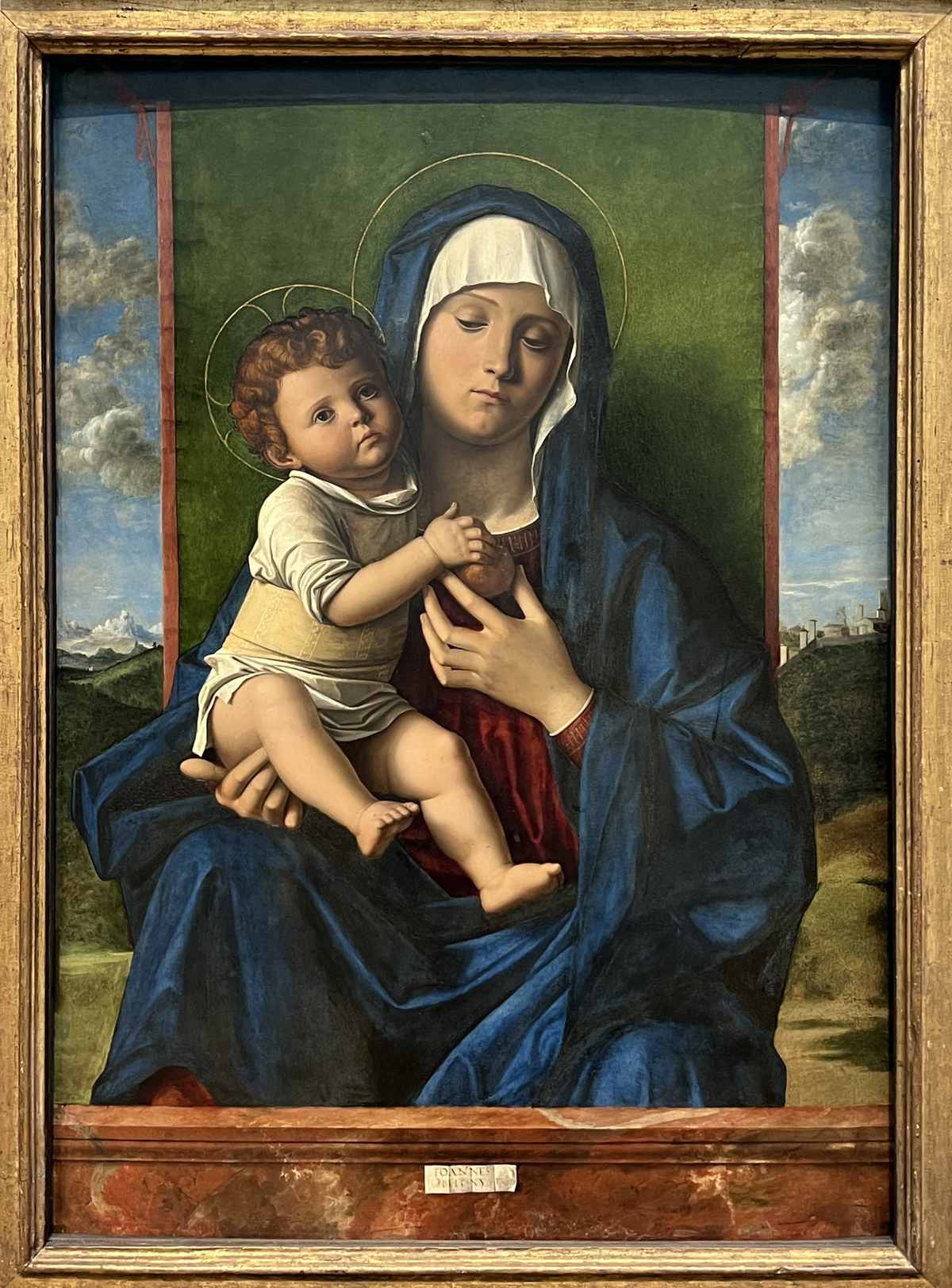
Giovanni Bellini — The Virgin and Child, probably 1480-90
Bellini's workshop produced many images of the Virgin and Child, but Bellini probably undertook this one himself for an important client. It may have been made for a small altar in a private chapel. The pomegranate – a symbol of Christ's Passion and Resurrection – was added at a late stage, requiring changes to the hands and arms of the figures.
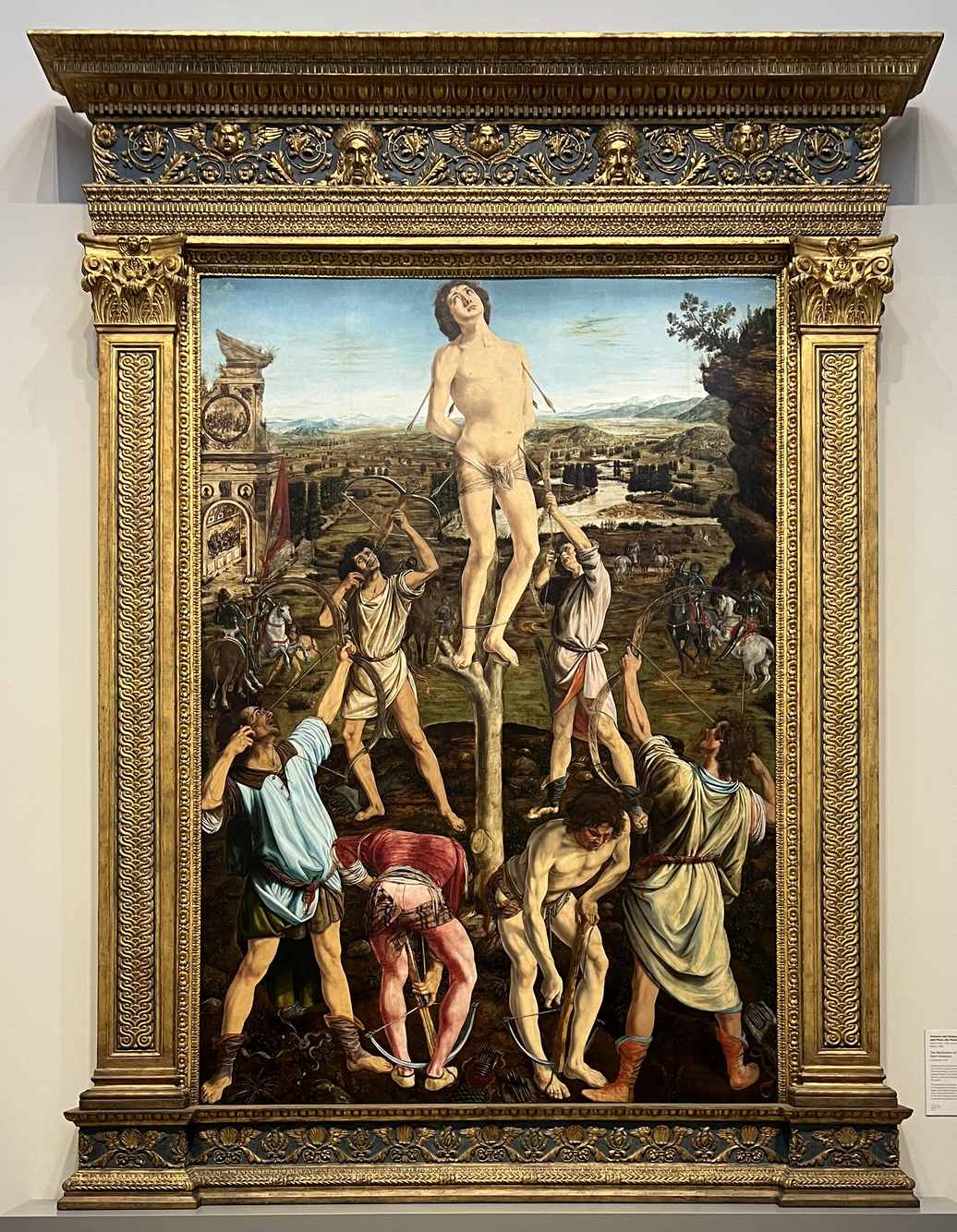
Antonio del Pollaiuolo and Piero del Pollaiuolo — The Martyrdom of Saint Sebastian, completed 1475
Sebastian was a Roman soldier who was killed for converting to Christianity. Pierced by arrows, he looks serenely towards heaven. His executioners strike dynamic poses as they prepare to take aim again. The altarpiece is excitingly experimental in its approach to oil paint. Daubs, drips and scratches represent distant trees, water and feathers. It was made for the Pucci family's private chapel at Santissima Annunciata, Florence.
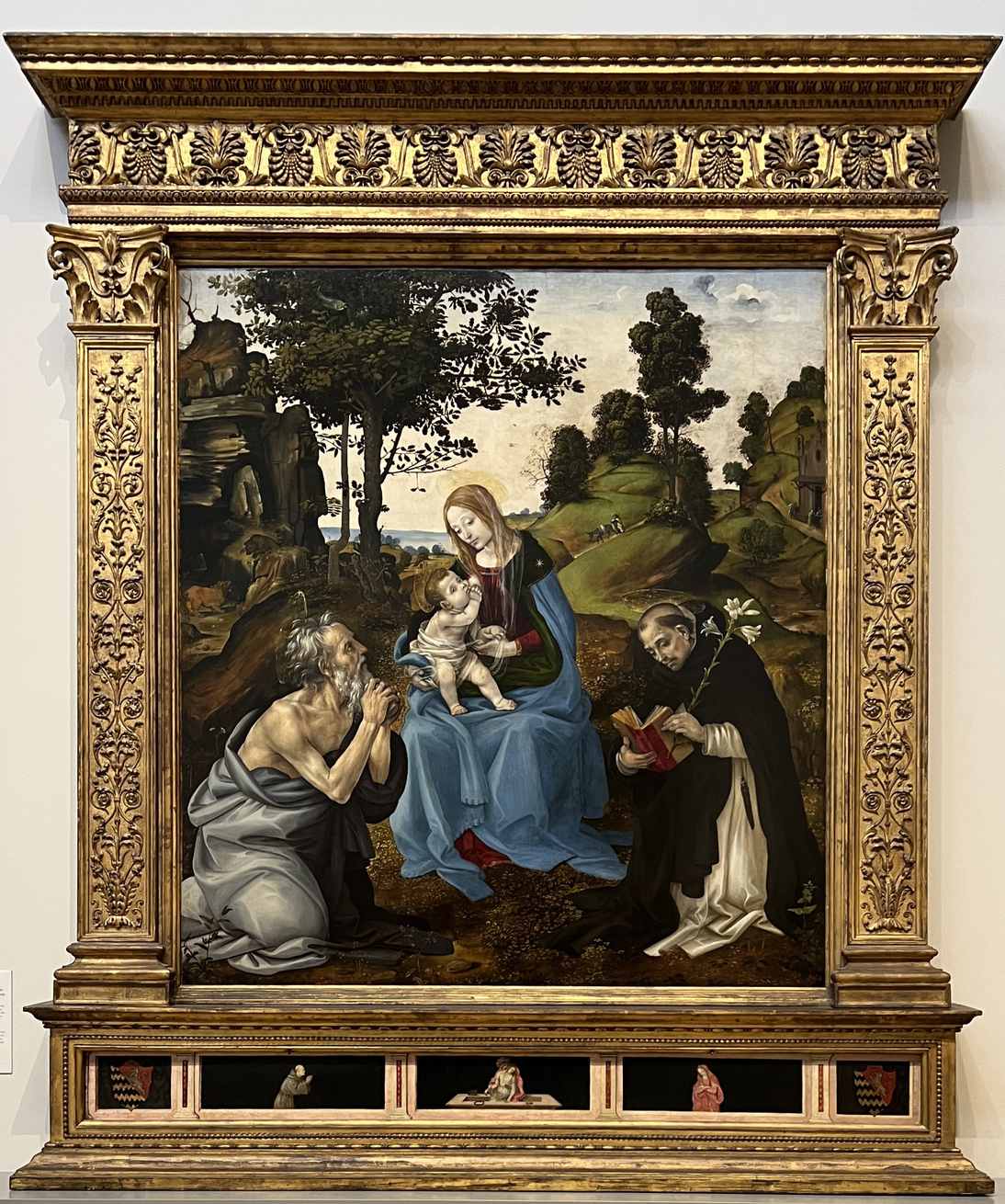
Filippino Lippi — The Virgin and Child with Saints Jerome and Dominic, about 1485
As Saint Jerome gazes adoringly at the Virgin nursing her son, Saint Dominic remains absorbed in his reading. In the distance, to the left, Jerome appears again in a dark cave, its entrance protected by his companion lion. In the predella (base), Saint Francis and Mary Magdalene look towards the central image of the dead Christ in his tomb. The altarpiece was painted for the burial chapel of the Rucellai family at San Pancrazio in Florence.
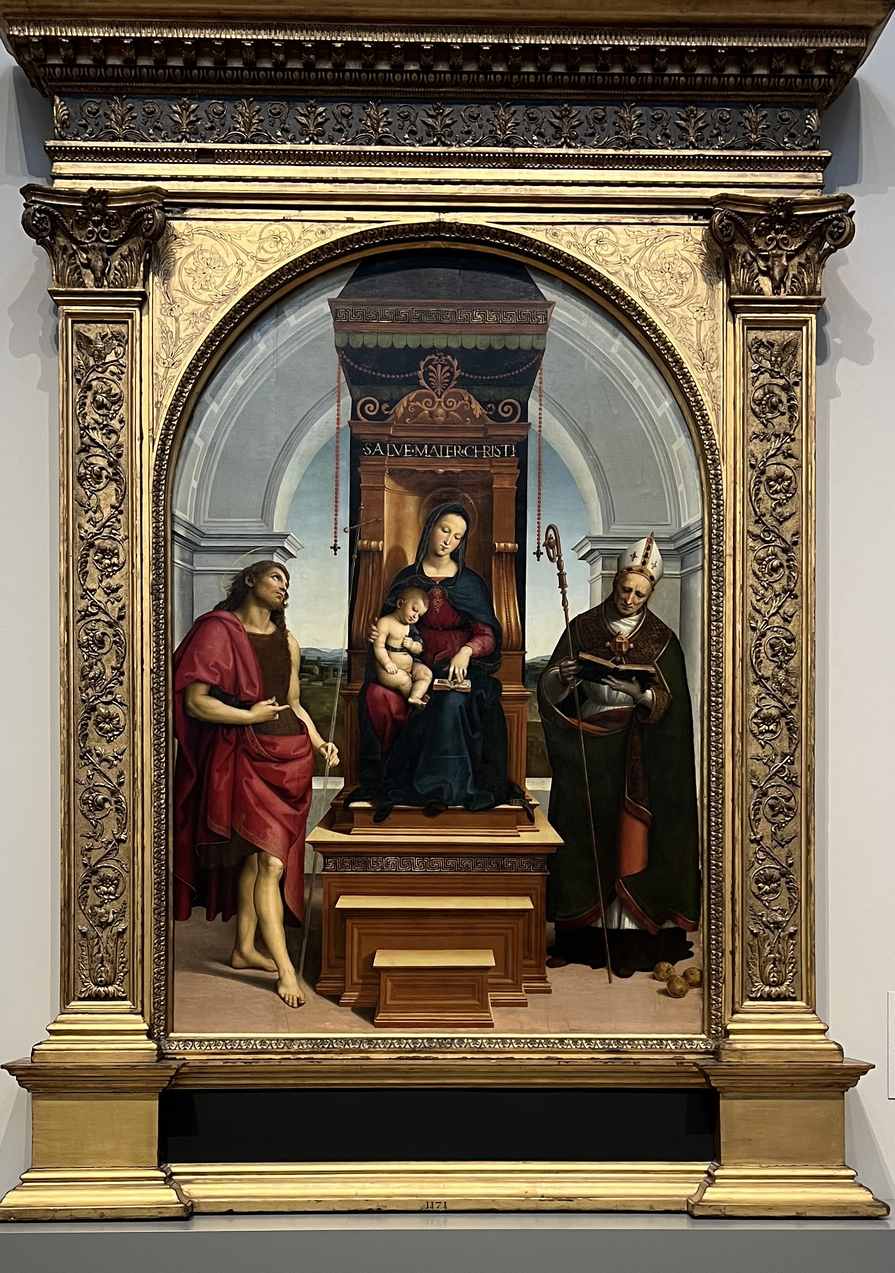
Raphael — The Ansidei Madonna, 1505
Raphael painted this altarpiece for the Ansidei family chapel in Perugia in 1505. This was shortly after his move to Florence, where he encountered and absorbed new artistic ideas. His figures became more monumental and his construction of pictorial space bolder. Light enters the picture from the right, responding to the original location of the altarpiece. Raphael later added the architecture behind Mary's throne. The suspended coral beads and inscription 'SALVE MATER CHRISTI' ('Hail Mother of Christ') remind viewers to say a set of prayers known as the Rosary.
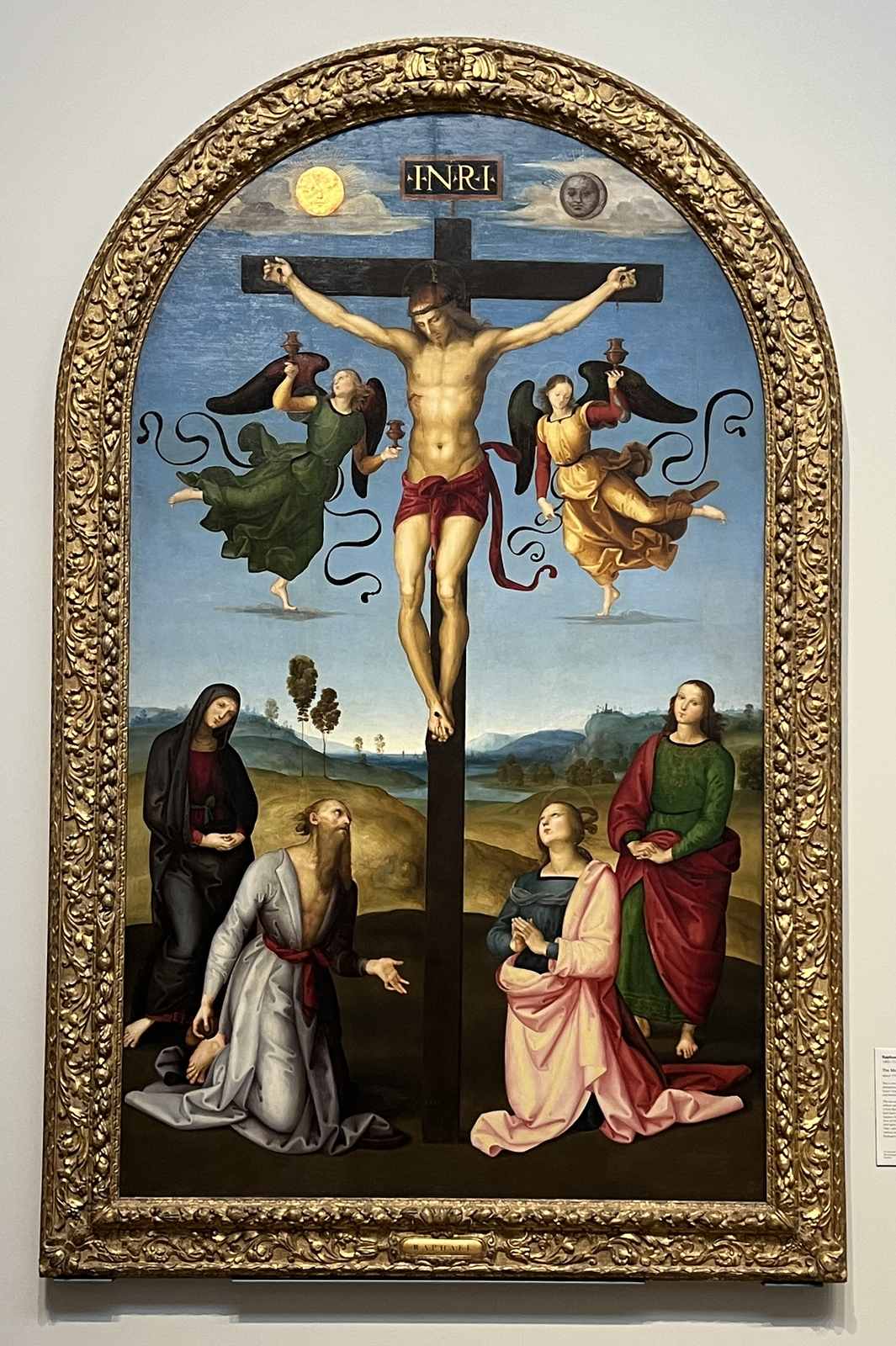
Raphael — The Mond Crucifixion, about 1502-3
This is one of Raphael's earliest altarpieces. He produced it for the burial chapel of the wool merchant and banker Domenico Gavari in Umbria. The sun and moon refer to the lunar eclipse said to have occurred when Christ died. Saint Mary Magdalene and Saint Jerome (the patron saint of Gavari's first-born son), kneel at the foot of the Cross, while the Virgin Mary and Saint John stand at either side. Their calm expressions and the luminous colours reveal the strong influence of Raphael's teacher Pietro Perugino.
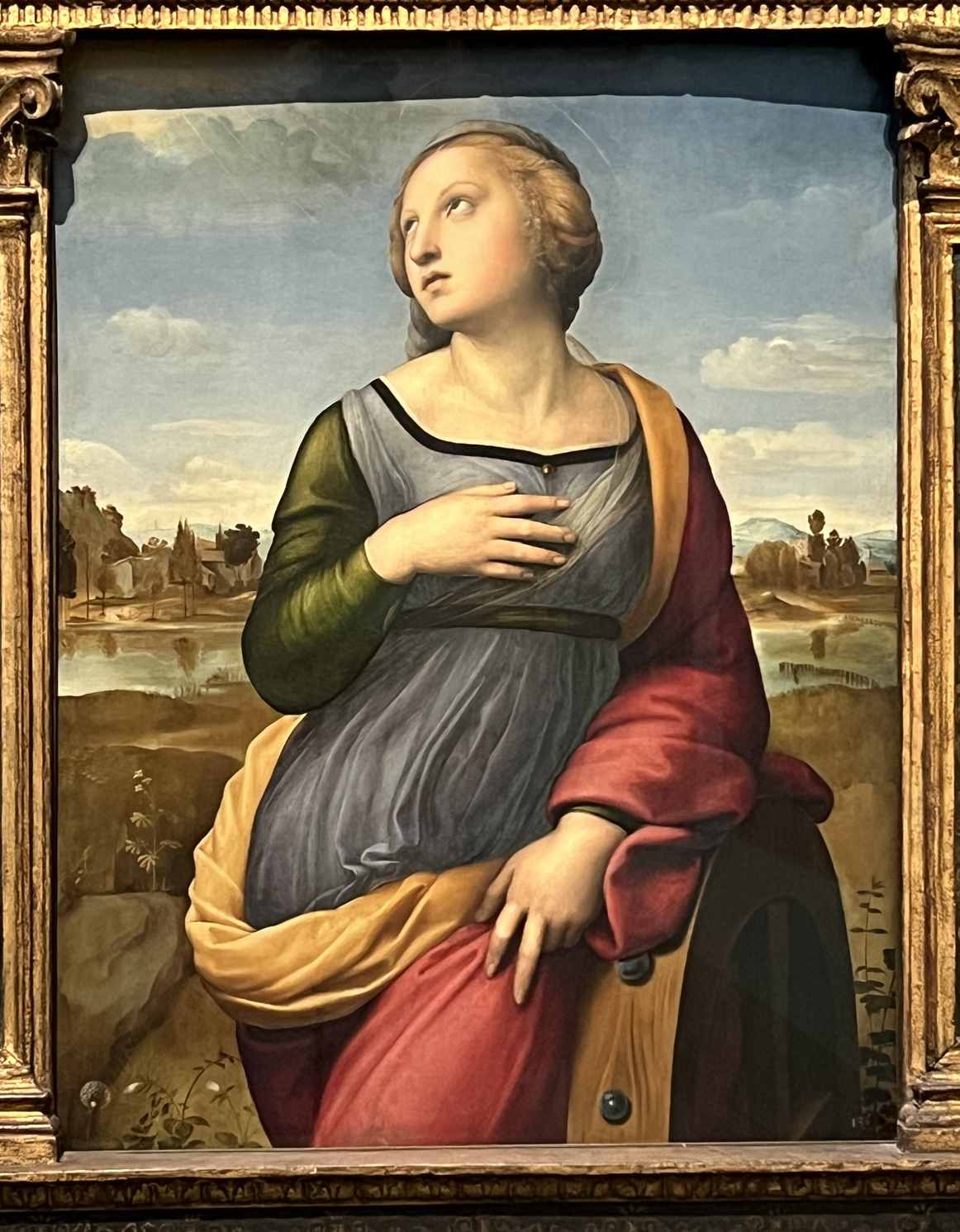
Raphael — Saint Catherine of Alexandria, about 1507
Saint Catherine was an early Christian princess who was tortured on a spiked wheel and later died for her faith by being beheaded. This painting marks a fundamental shift in the young Raphael's art after he moved to Florence and was exposed to new artistic influences. Catherine's twisting pose and powerful physique are inspired by Michelangelo's sculptures, while the more subtle modelling derives from the work of Leonardo da Vinci.
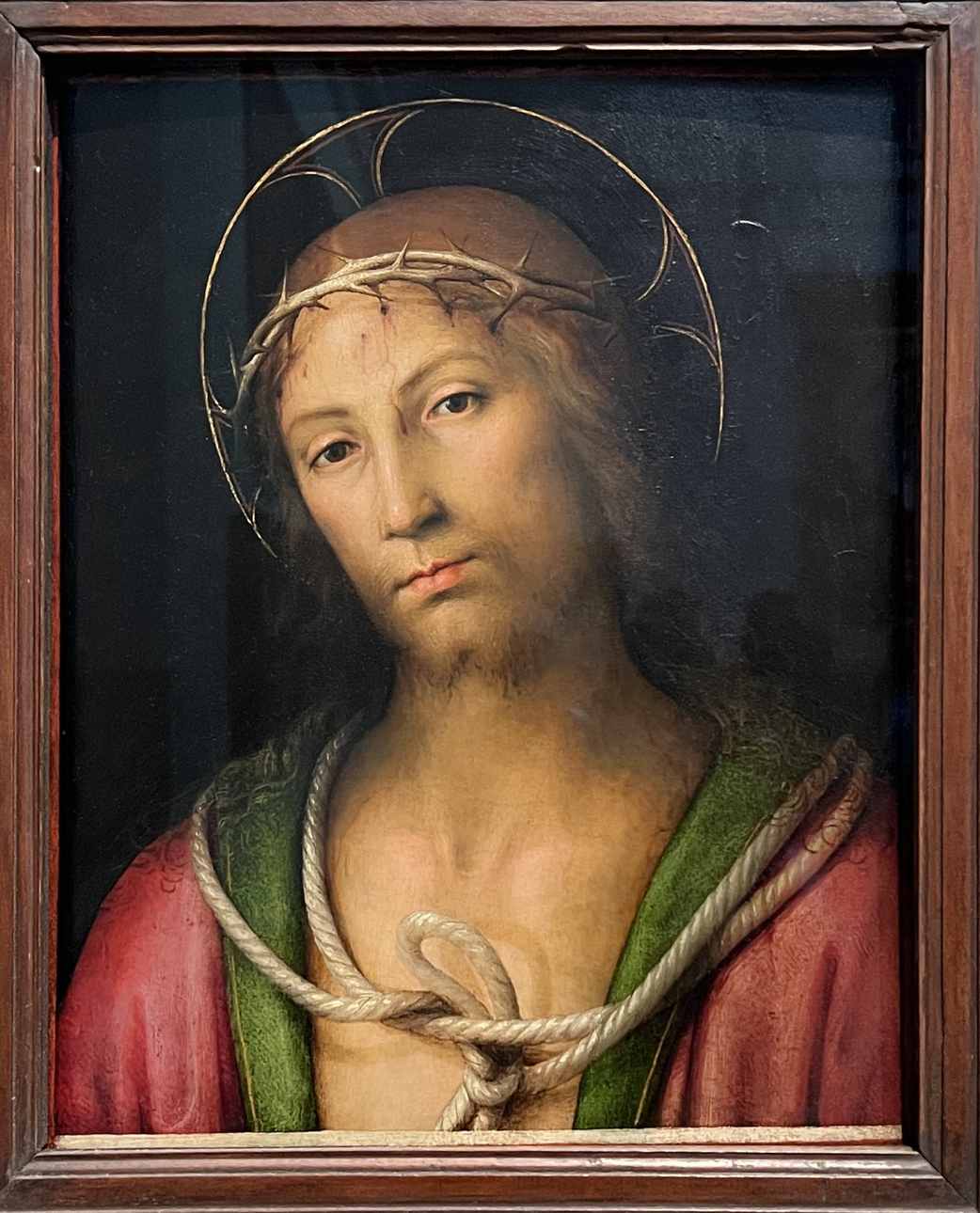
Probably by Pietro Perugino — Christ Crowned with Thorns, about 1500-05
According to the New Testament of the Bible, Christ was tortured and mocked by a crowd before dying on the Cross. The picture isolates that moment of suffering and humiliation and turns it into a dignified portrayal of Christ's humanity. Originating in Northern Europe, such images spread to Italy. They were intended for private prayer and contemplation of Christ's sacrifice.
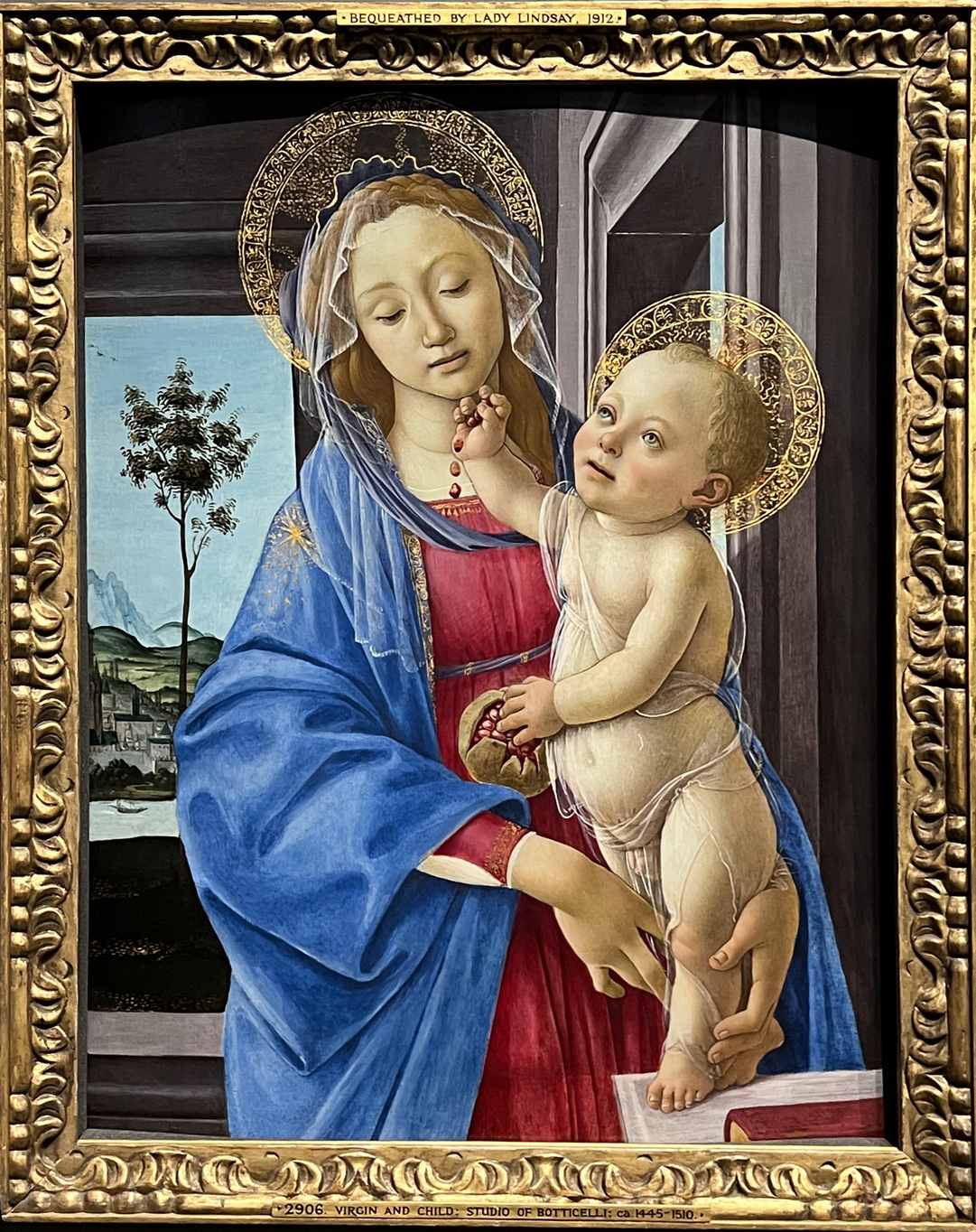
Workshop of Sandro Botticelli — The Virgin and Child with a Pomegranate, probably about 1480-1500
As Christ raises his hand towards his mother, pomegranate seeds spill from his grasp. Their red colour recalls the prayer beads of a rosary, but also drops of blood, hinting at his future sacrifice. Botticelli's workshop specialised in images of the Virgin and Child. Here, the blue sky extends beneath the architecture and the faces of the figures. This suggests that two painters may have worked together on the panel, one painting the landscape and another later adding the figures.
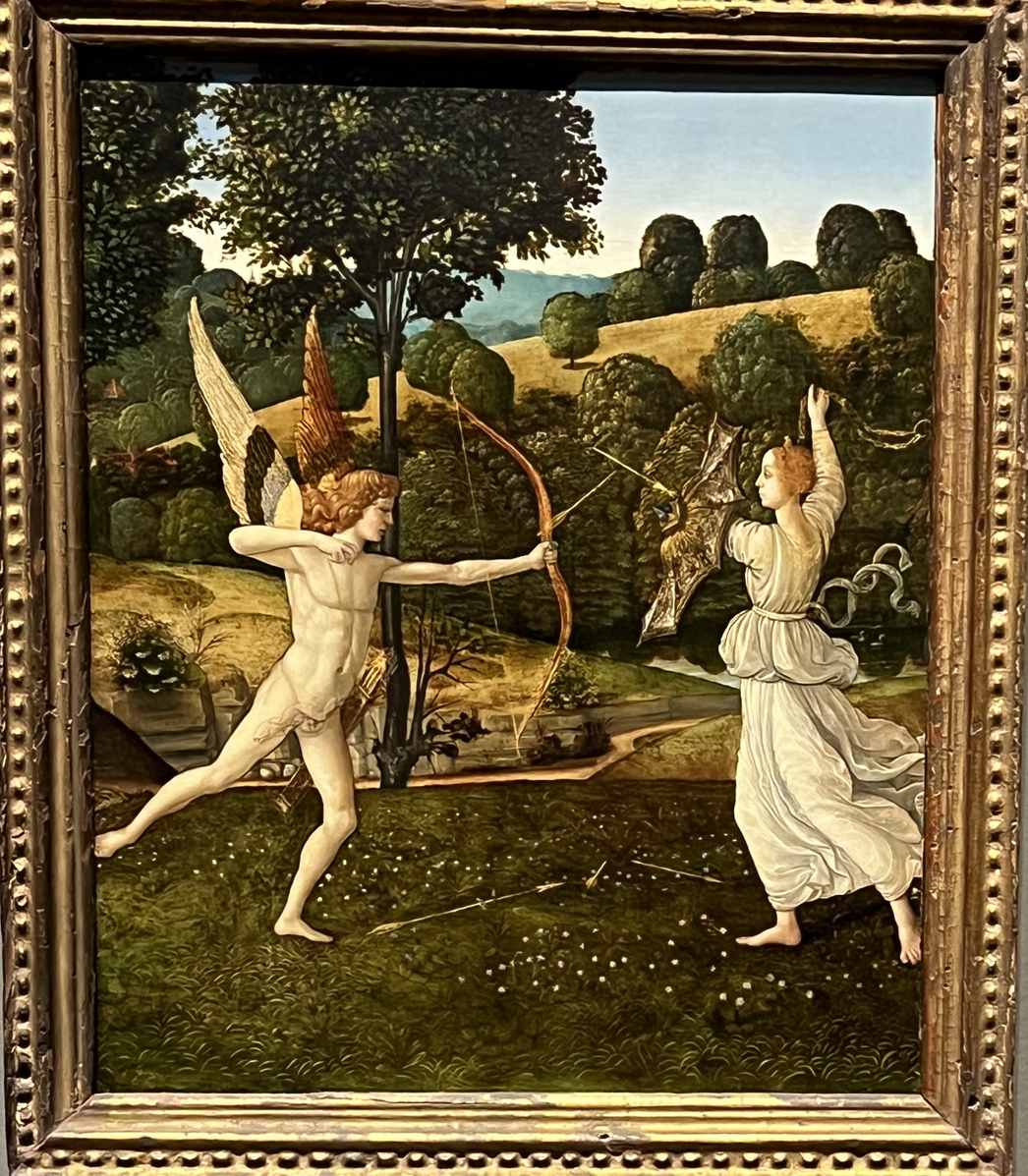
Gherardo di Giovanni del Fora — The Combat of Love and Chastity, probably 1475-1500
The rounded treetops and rolling hills resemble those in Netherlandish paintings that the artist would have seen in Florence. Love's arrows shatter against Chastity's shield. In her other hand she wields the chain that will eventually subdue and bind Love. Illustrating Petrarch's poem The Triumph of Chastity, the picture may have been part of a larger horizontal panel decorating a marriage chamber, or perhaps the cover or reverse of a portrait.
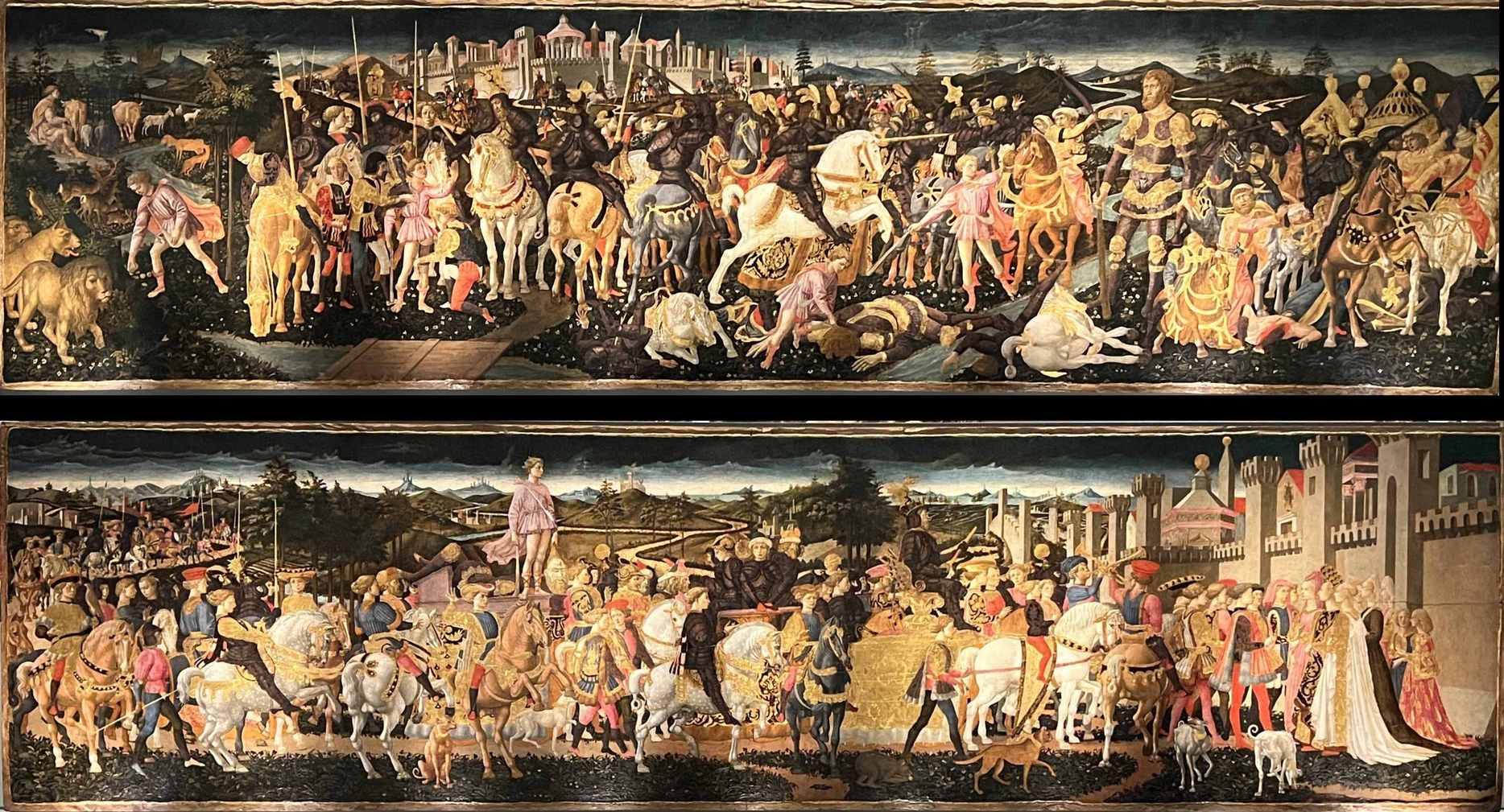
Francesco Pesellino — The Triumph of David, about 1445-55
This panel continues Pesellino's The Story of David and Goliath. Saul's victorious army returns to Jerusalem. David stands at the centre holding Goliath's head. A group of splendidly dressed women come to greet the procession. The panel shows Pesellino's unusually precise use of gold and silver leaf. Rather than paint over large areas of gilding, he used small, individually cut pieces of metal leaf. These are attached across the panel in individual horseshoes, the feather decorations of the pink dress, and the brocade sleeves of some riders.
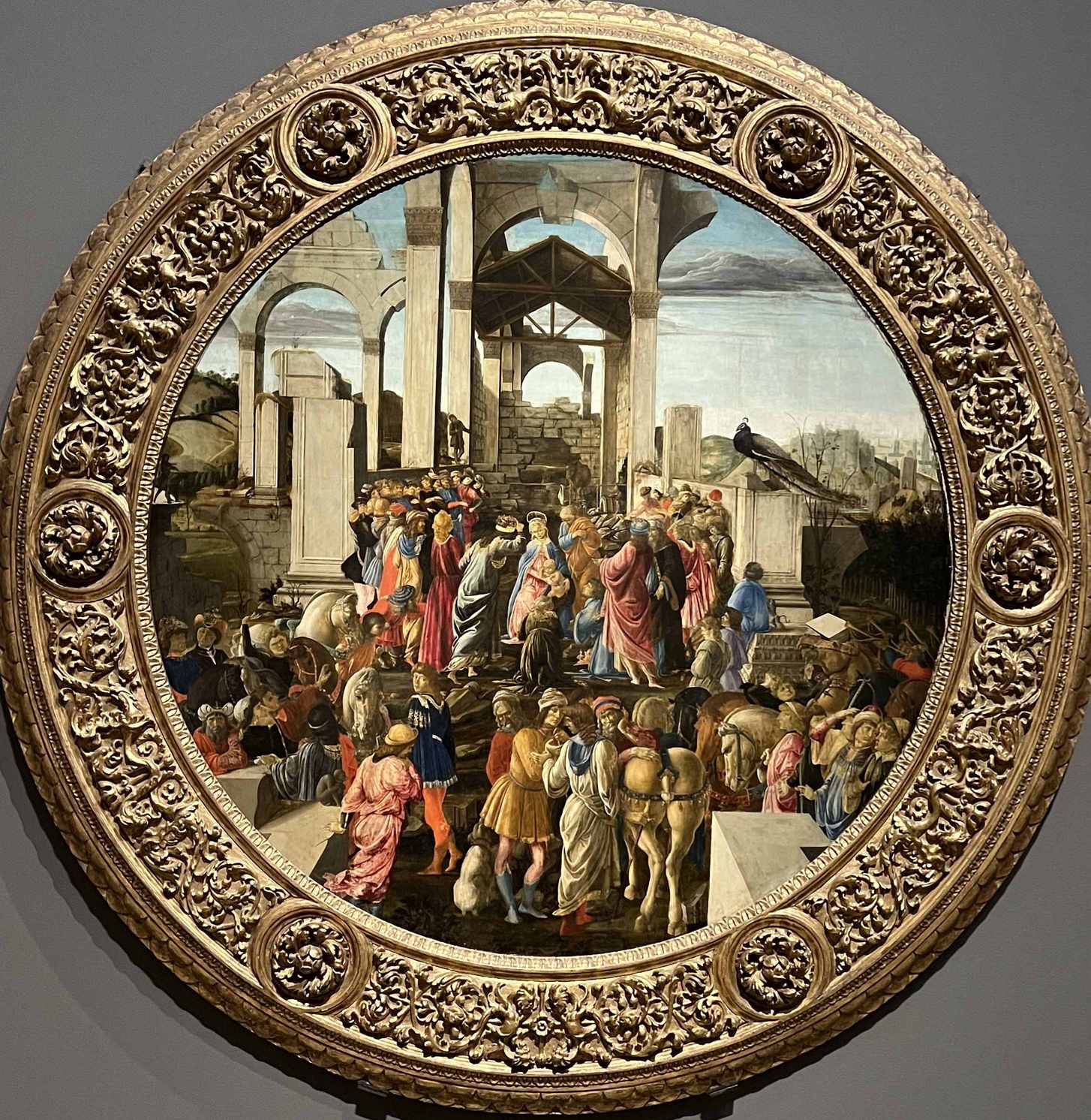
Sandro Botticelli — The Adoration of the Kings, about 1470-5
The Holy Family sits in the ruins of a vast temple, attended by the Three Kings and their bustling retinue. Depictions of the Adoration of the Kings were popular in Renaissance Florence. Tondi (round paintings) like this often decorated palaces in the city. This work may have been made for the Pucci family, allies of the ruling Medici who strongly identified with the Three Kings.
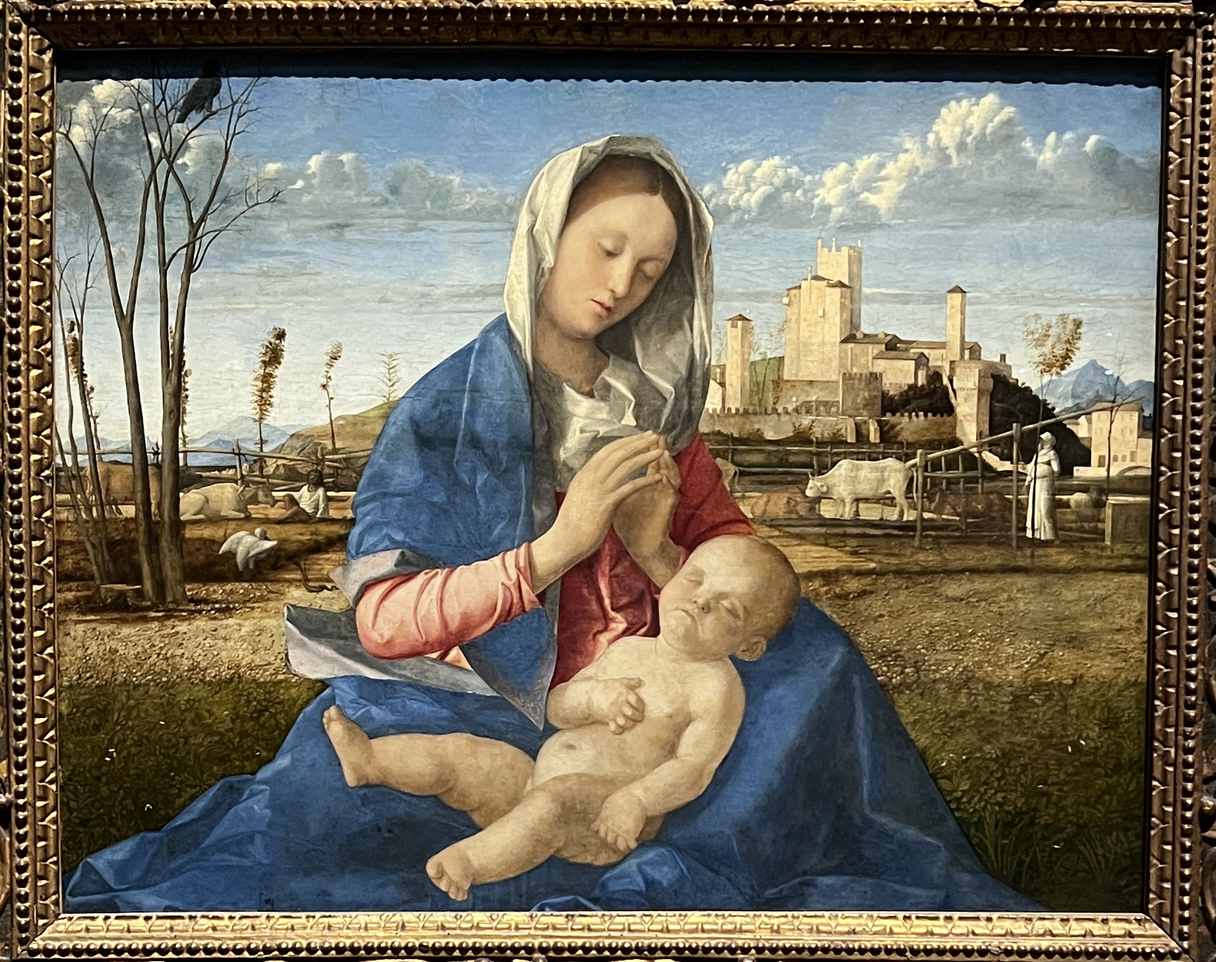
Giovanni Bellini — Madonna of the Meadow, about 1500-5
Giovanni Bellini was one of the first Italian painters to use natural settings to enhance the meanings of his pictures. These are the farmlands of mainland Venice. It is spring, the season of Christ's Passion (his torture and crucifixion). The Virgin sits with her son asleep across her lap. The pose, and the child's deathly pallor, foreshadow her lamentation over Christ's dead body. The naked trees and vulture on the branch also allude to his future death.
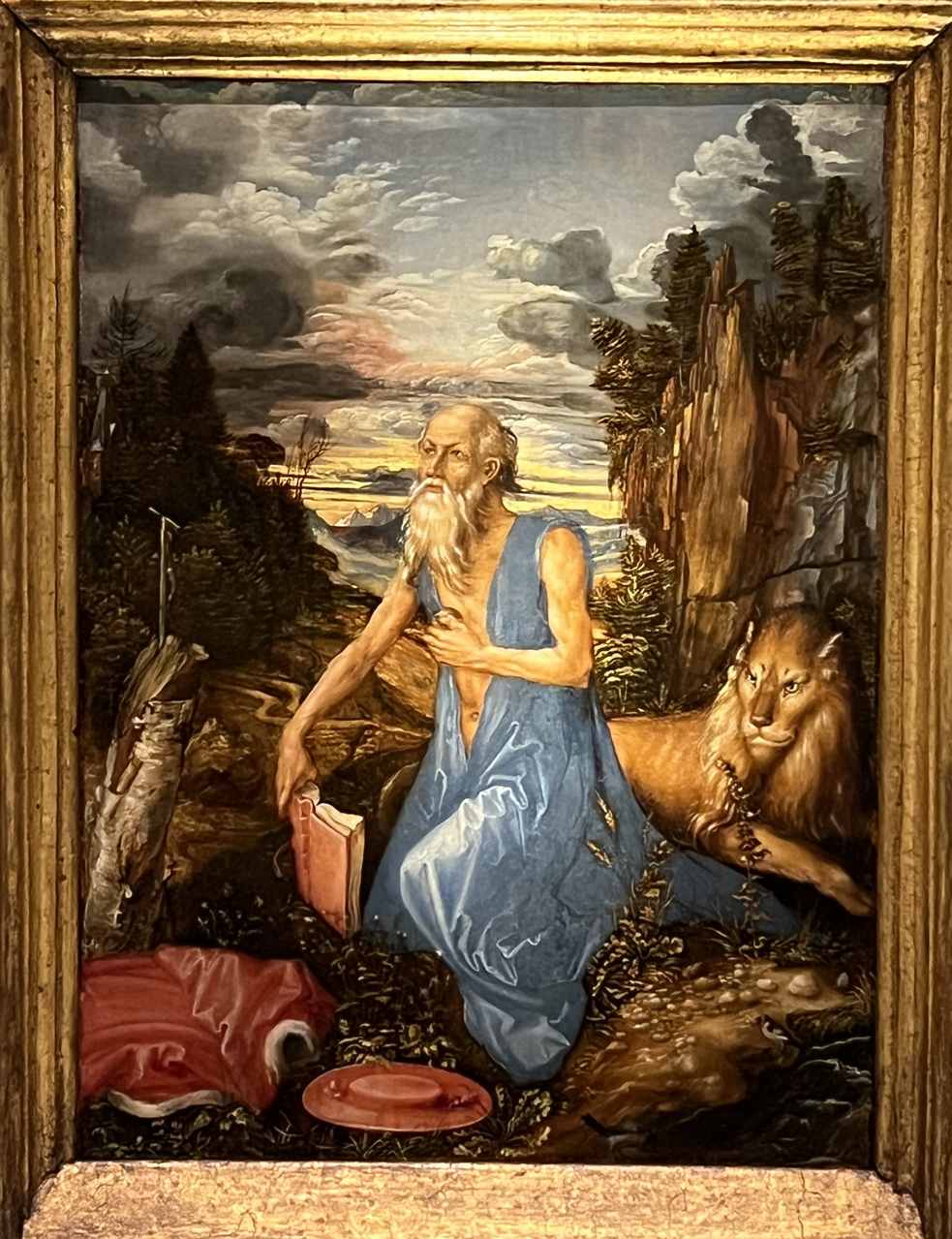
Albrecht Dürer — Saint Jerome, about 1496
German artist Albrecht Dürer travelled twice across the Alps to Venice. This panel was almost certainly painted after his first visit to the city in 1494/5. Saint Jerome is presented as a hermit in the wilderness, beating his chest with rocks in empathy with Christ's Passion (his torture and crucifixion). The mountainous setting is drawn from Dürer's detailed studies of landscapes, plants and animals. The dazzlingly colourful sunrise (or sunset) suggests his knowledge of effects achieved by Venetian painters like Giovanni Bellini.
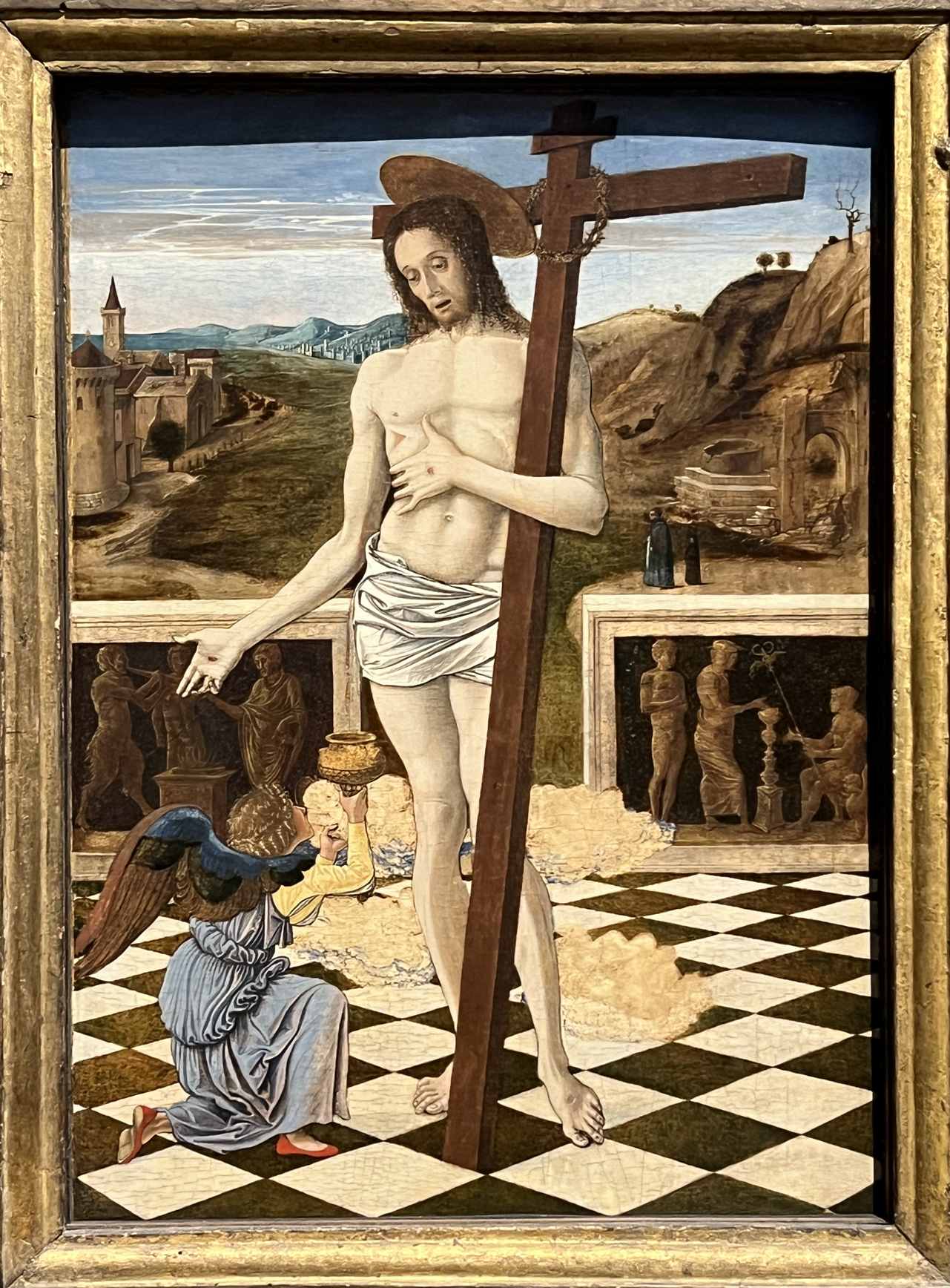
Giovanni Bellini — The Blood of the Redeemer, about 1465
This painting may once have been the door of a tabernacle – a container intended to hold the bread consecrated as Christ's body during Mass. Blood pours from the wound in his side into a chalice held by a kneeling angel. This represents the wine consecrated during Mass. Classical reliefs behind show the pagan rites replaced by Christianity.
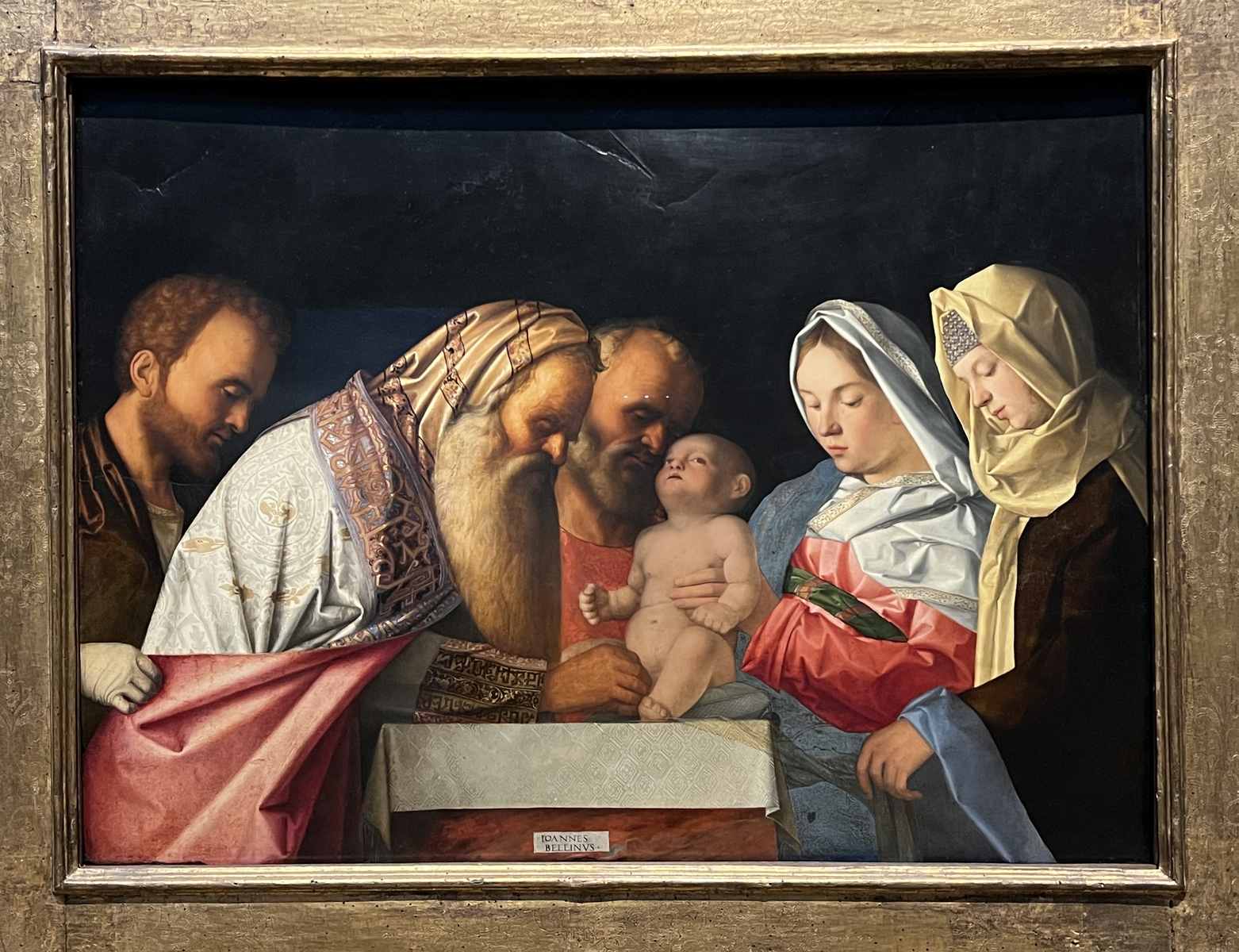
Workshop of Giovanni Bellini — The Circumcision, about 1500
This painting reworks one of Bellini's most popular compositions. The New Testament tells how Christ was circumcised and named soon after his birth, in line with Jewish religious practices. The moment was significant to Christians as the first time Christ's blood was spilled, foreshadowing his future sacrifice. The subject was popular in Venice, particularly among groups dedicated to the name, blood or even foreskin of Christ. Here, Christ clenches his fists, bravely bearing the pain.
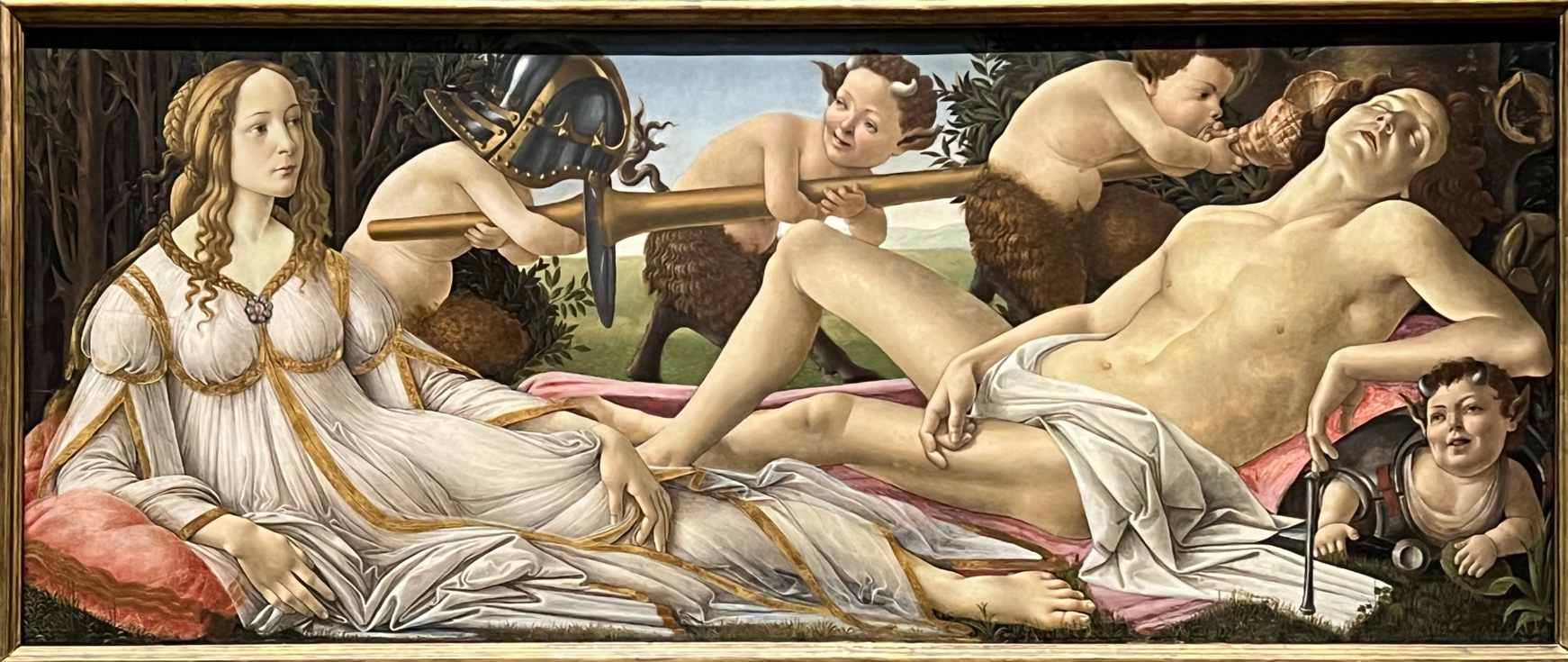
Sandro Botticelli — Venus and Mars, about 1485
Venus reclines clothed and alert as she contemplates her naked lover. Mars sleeps so deeply that he does not notice the boisterous young satyrs, or the wasps buzzing beside his head. These insects (vespe in Italian) may refer to the Vespucci family, who possibly commissioned the painting. It draws on Antique sculpture, Classical painting and contemporary poetry, but can also be read as a joke about male and female sexual satisfaction. It was once set into the wall-panelling of a Florentine bedchamber.
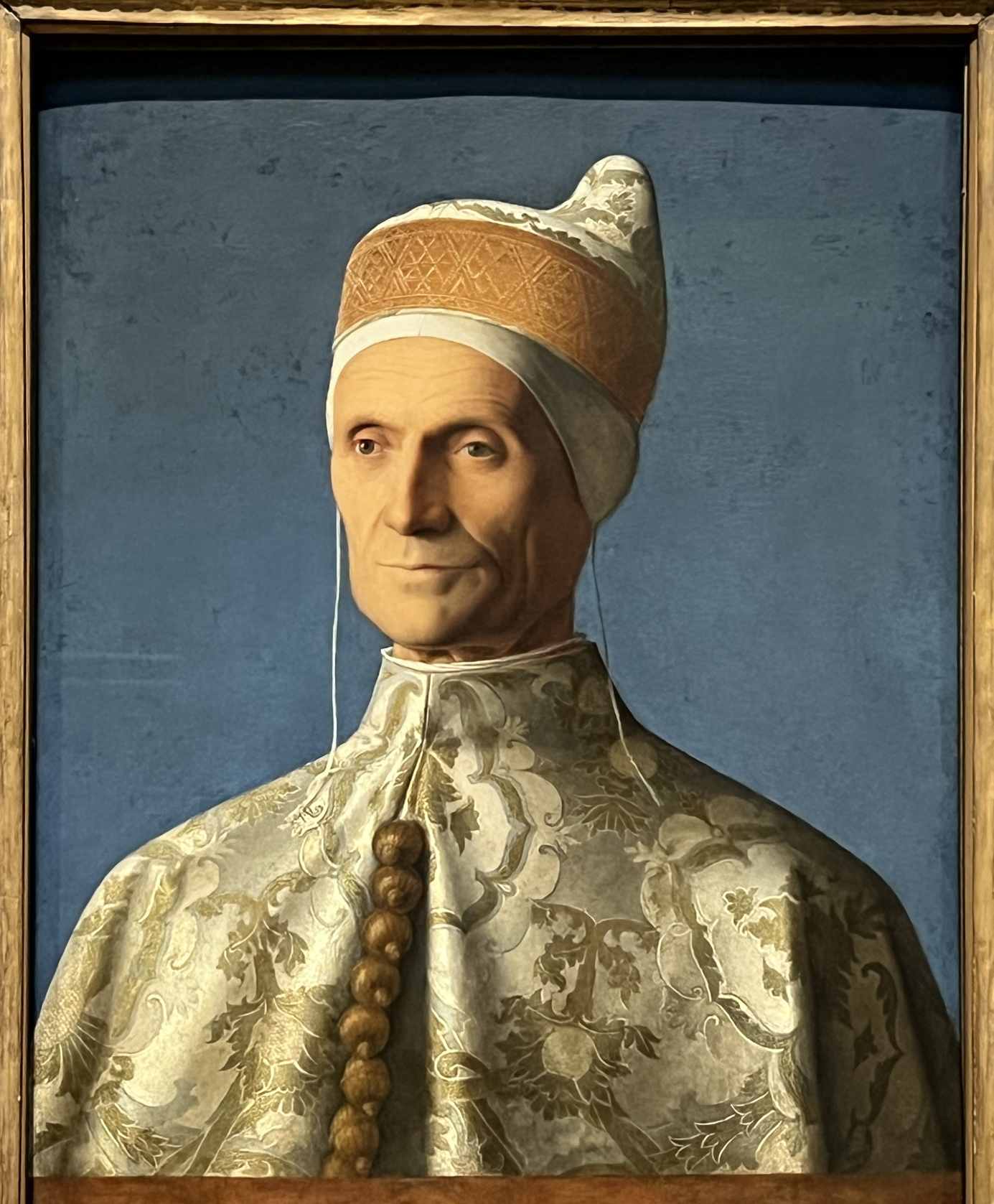
Giovanni Bellini — Doge Leonardo Loredan, about 1501-2
This exceptional portrait is both an official image and an intimate likeness. It captures the qualities expected of an ideal leader. Justice, austerity, serenity and kindness are conveyed in his half-stern, half-smiling expression. Loredan wears the ceremonial horned hat, linen cap and robe of the doge (the head of the Republic of Venice). The marble parapet recalls both a windowsill and a shelf to hold a sculpted portrait bust. The blue sky evokes the passing of time.
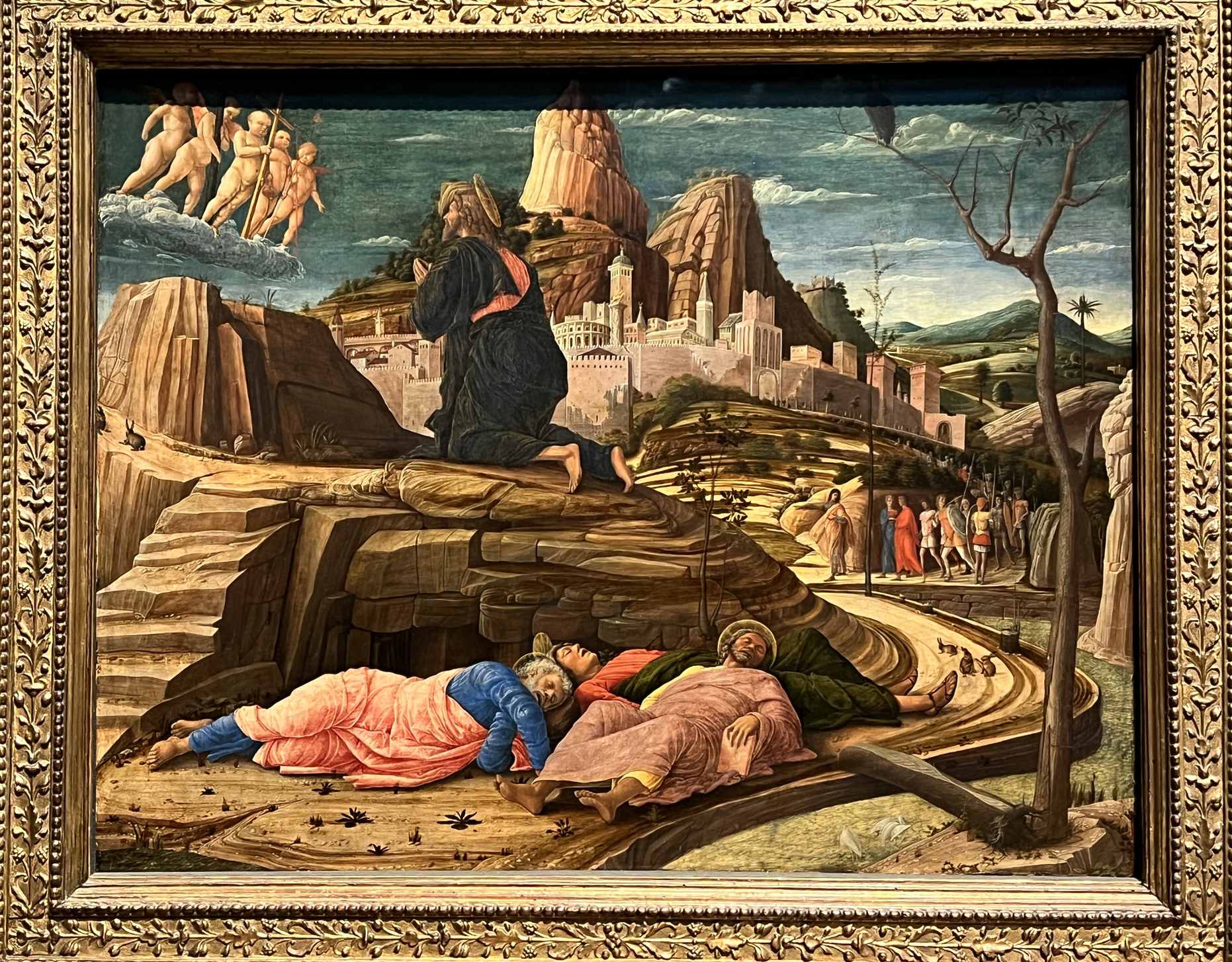
Andrea Mantegna — The Agony in the Garden, about 1455-6
Christ kneels before an open-air altar cut from the rock. He must resign himself to his approaching death. His face is partly hidden as he contemplates what is ahead. The Cross, lance and other instruments of his Passion (torture and crucifixion) are presented by putti. In the distance, Judas leads Christ's approaching captors through the barren, hostile landscape.
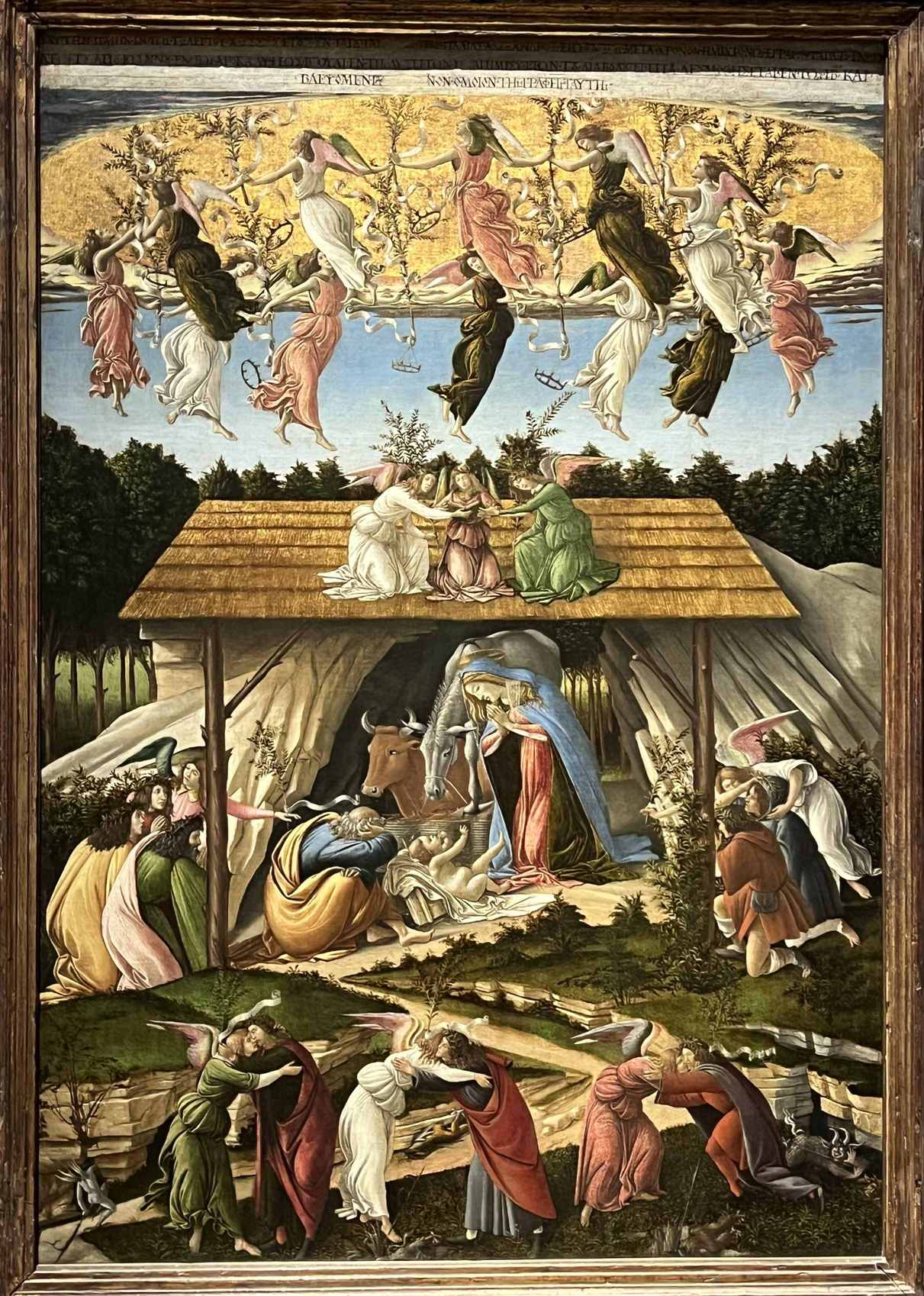
Sandro Botticelli — 'Mystic Nativity', 1500
The year 1500 marked a moment of anxiety in Europe. Fears of the Apocalypse had been fuelled in Florence by the Dominican reformer Girolamo Savonarola (1452-1498), who preached about the coming of the Antichrist and urged his congregations to repent. This painting was made during this troubled time. Rendered in mordant gilding, the realm of Heaven opens above the stable of the Nativity as angels join hands to praise the Virgin. In the foreground, virtuous men embrace angels as demons are banished into darkness.